

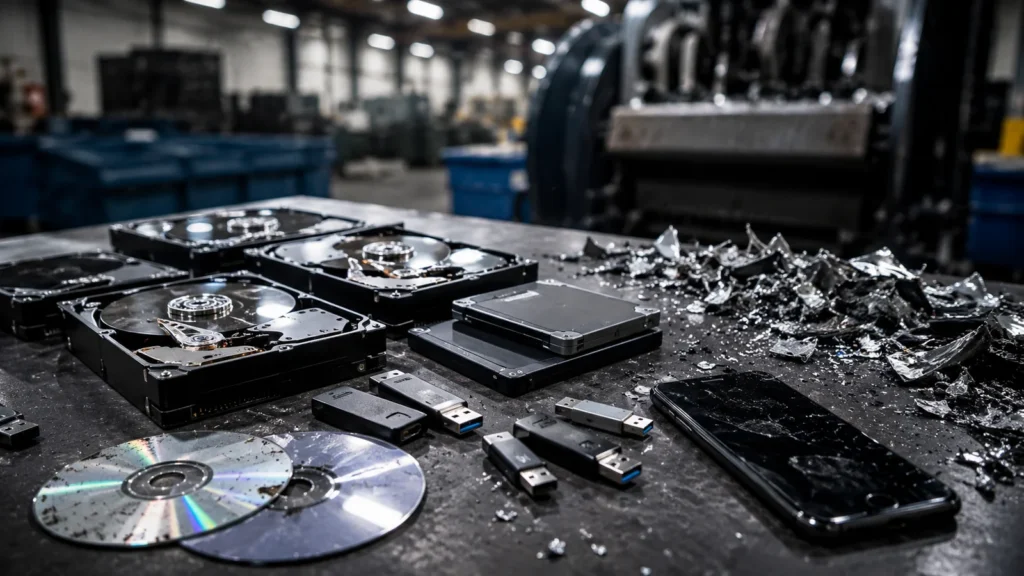
Banks, lenders, insurers and investment firms hold account numbers, card details, ID documents and credit files. When laptops are replaced or a server room is cleared, that data stays on the old drives. Hard drive shredding for finance makes sure it can never be recovered, and gives you proof that it was destroyed.
Total Shred destroys hard drives, SSDs and other storage for financial firms across the UK. You can watch your drives being shredded at your premises. Every job comes with a certificate of destruction listing each drive’s serial number.
Why hard drive disposal in finance needs extra care
UK GDPR. Personal data must stay secure until it is destroyed. A drive sold or dumped with customer data on it is a reportable breach.
FCA outsourcing rules. Using a supplier does not move the responsibility away from your senior managers. The FCA’s SYSC 8 rules expect you to choose suppliers carefully and check their work.
PCI DSS. If you take card payments, PCI DSS requirement 9.4.7 says media holding cardholder data must be destroyed, or the data made unrecoverable, once it is no longer needed.
Keep, then destroy. MiFID records must be kept for at least five years. Under the Money Laundering Regulations 2017, customer due diligence records are kept for five years after a relationship ends, then deleted.
In 2022, Morgan Stanley paid a $35 million US penalty after a moving company with no data destruction experience sold its old drives. Customer data later turned up on an auction site. The supplier you choose matters as much as the method.
Where data hides in a financial firm
- Branch and office PCs and laptops
- Servers and storage from data centre clear-outs
- Backup tapes and archived media
- Call recording systems
- Printers and photocopiers with built-in hard drives
- Phones, tablets and USB sticks
Financial services IT disposal, step by step
- List your assets. Record the serial number of every drive before it leaves service.
- Choose on-site or off-site. Decide whether drives are shredded at your premises or collected.
- Destroy the drives. Drives are logged, moved securely, then shredded or crushed beyond recovery.
- Check the certificate. Match the serial numbers on your certificate of destruction to your asset list.
- Recycle. What’s left is recycled under WEEE regulations.
For whole devices rather than loose drives, see our IT equipment disposal service.
Hard drive shredding for banking: on-site or off-site?
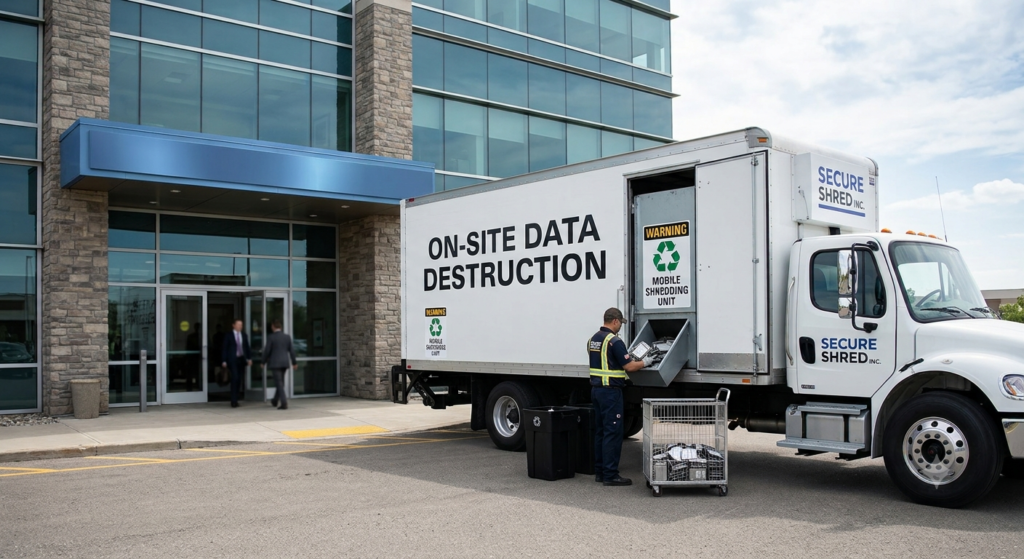
On-site. Our mobile hard drive shredding unit comes to you, so drives never leave your control. Your team can watch, and our trucks have security cameras that record the shredding.
Off-site. For larger volumes, drives are collected in tamper-proof containers and destroyed at our secure facility.
Shredding also works on failed or damaged drives that software can’t wipe. Our guide to shredding vs wiping explains more.
What to look for in a supplier, and how Total Shred compares
- BS EN 15713. We carry out destruction to this British Standard.
- Vetted staff. Our drivers and operators are vetted to BS 7858 and hold Enhanced DBS checks.
- Proof for every drive. Each job comes with a certificate of destruction listing serial numbers.
- Evidence on request. Photo or video evidence is available if your auditor asks.
- Quality and environment. We are ISO 9001 and ISO 14001 certified.
We’re trusted by councils, embassies, the NHS and corporate clients. We can also shred your confidential paper, so you get one supplier for everything.
Book hard drive shredding for your firm
Find out more about our hard drive destruction service, call 0800 298 4009, email shred@total-shred.com, or request a quote.
FAQ
What is hard drive shredding for finance?
It is the physical destruction of hard drives, SSDs and other storage used by banks, lenders, insurers and investment firms, so customer data can never be recovered. Each job should come with a certificate of destruction listing every serial number.
Is wiping enough for bank hard drives?
Wiping relies on software working on every drive, and damaged drives can’t be wiped at all. Shredding physically destroys the drive, which removes any doubt and is easier to prove to an auditor.
How long do financial firms keep records before destroying them?
MiFID records must be kept for at least five years. Customer due diligence records are kept for five years after the relationship ends. After that, the data should be destroyed securely.
Can we watch our hard drives being shredded?
Yes. Our mobile unit shreds drives at your premises so your team can watch. Our trucks also have security cameras that record the shredding.
How much does hard drive disposal for banking cost?
Hard drive shredding starts from £5 per device, with bulk pricing for larger volumes. Contact us for a quote.