

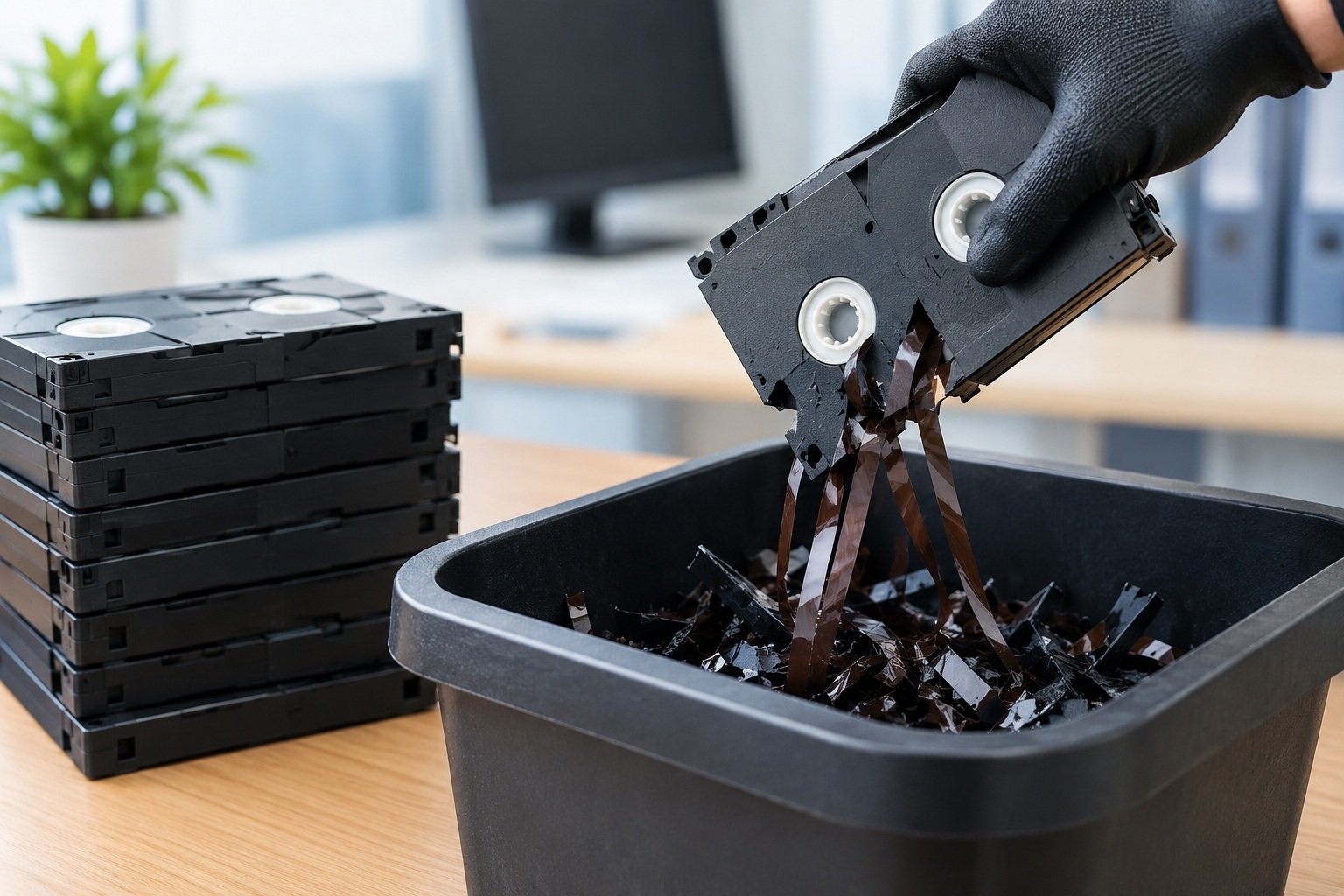
Most organisations have a box of old backup tapes somewhere: in a server room cupboard, an off-site archive, or left over from an IT upgrade years ago. They look harmless, but each cartridge can hold years of customer records, payroll files, emails and financial data, often as a complete copy of a server.
Tapes are built to last for decades, which makes them excellent for backups and a long-term risk once those backups are no longer needed. This guide explains how data tape disposal works, what your responsibilities are, which methods are reliable, and how to build a destruction process you can prove to an auditor.
Why Old Backup Tapes Are a Data Risk
A single tape can hold a full backup of a server, which is often far more data than a laptop. Unlike laptops, which usually get wiped when replaced, tapes tend to be forgotten. They outlive the backup systems that created them, then surface during an office move or clear-out and end up in general waste.
Tape drives can still be bought second hand, and data recovery specialists can read old or damaged tapes. Poorly disposed of storage media is a common cause of data breaches, and the belief that “nobody can read these anymore” is one of the main reasons.
Common formats include LTO, DLT, DAT and mainframe cartridges. If you’re unsure whether a tape holds data, treat it as though it does.
What Your Business Is Responsible For
Under UK GDPR, you must keep personal data secure for its whole life, and that includes the day you get rid of it. You also shouldn’t keep personal data longer than you need it, so tapes held “just in case” can be a compliance issue in their own right. Our guide on how long UK businesses need to keep records helps you check this before anything is destroyed.
Data breaches can lead to fines from the ICO, and the cost of informing customers and repairing lost trust is often even greater. The right destruction method depends on how sensitive the data is. Whichever you choose, the best protection is a documented process and a certificate of destruction for every batch.
Which Destruction Method Works for Data Tapes?
Reformatting and overwriting. Reformatting only rewrites the tape’s index, so the underlying data stays readable. Overwriting the whole tape can work, but it’s slow, needs a working compatible drive, and isn’t possible for damaged or obsolete tapes. For a large archive, it isn’t a realistic option.
Degaussing. A degausser uses a very strong magnetic field to scramble the data on the tape. It works well when done properly, but the machine must be powerful enough for the type of tape being erased. A degaussed tape also looks exactly the same as before, so there’s no visual proof, and it usually can’t be reused afterwards. Our guide on whether degaussing is enough for secure disposal covers this in more detail.
Physical shredding. Industrial shredders cut the cartridge, spool and tape into small pieces. The data can’t be put back together, and you can see it has been destroyed. This is why shredding is the standard method for backup tape destruction.
Degaussing followed by shredding is the strongest option for finance, health, legal and government data. Degaussing erases the data, shredding destroys the tape, and each step backs up the other.
DIY methods don’t work. Cutting the ribbon leaves long readable sections, household magnets are far too weak, burning releases toxic fumes, and office shredders can’t handle cartridges. They also leave no evidence, a problem we cover in our article on DIY hard drive destruction risks.
A Secure Destruction Process in Six Steps
- Locate every tape. Check server rooms, archive stores, branch offices and third-party storage, where tapes are often split across sites.
- Create an inventory. Record each barcode or label and, where known, the system it came from. This inventory becomes your audit trail.
- Confirm retention periods. Restore anything that must still be kept for legal, tax or contractual reasons before destruction.
- Secure the tapes. Store them in a locked room or container until collection. Don’t leave them in open boxes.
- Use certified shredding services. Choose a BS EN 15713 provider that offers on-site shredding or tracked collection with a full chain of custody.
- Reconcile the paperwork. Check the certificate of destruction against your inventory, file it with the waste transfer note, and update your asset register.
Tape Disposal as Part of IT Asset Destruction
Tapes are usually retired alongside other equipment, during a server replacement, a move to cloud backup or an office relocation. Handling them within a single IT asset destruction project means tapes, hard drives, SSDs, servers and laptops share one chain of custody and one set of certificates. That makes the whole job quicker to run and simpler to audit. See our IT asset disposal guide or our IT equipment disposal services for more.
How Total Shred Handles Backup Tape Destruction
Total Shred provides secure shredding services for data tapes, hard drives and other media across the UK, with most of our work in London and the South East. We follow BS EN 15713, hold ISO 9001 and ISO 14001 certification, are Cyber Essentials certified and are members of the BSIA.
Our destruction process is built around your requirements:
- On-site shredding. Our mobile shredding truck destroys your tapes at your premises while you watch.
- Secure collection. Security-vetted staff transport tapes in locked containers and GPS-tracked vehicles to our facility, which runs under 24/7 CCTV with controlled access.
- Degaussing and shredding. For highly sensitive data, tapes can be degaussed before shredding, on-site or off-site.
Every job includes a certificate of destruction and a waste transfer note, and shredded material is recycled wherever possible. Whether you have one box of old tapes or thousands of cartridges from a data centre clear-out, our secure hard drive and media destruction service can handle it, alongside paper or IT disposal in the same visit if needed.
Call 0800 298 4009 or get a free quote today.
Frequently Asked Questions
Can data be recovered from old backup tapes?
Yes. Tapes are built to last for decades, and data recovery specialists can read old or damaged tapes. Unless a tape has been properly degaussed or shredded, you should assume the data can still be recovered.
Is reformatting a backup tape enough to erase it?
No. Reformatting only changes the tape’s index. The actual data stays on the tape and can be read with recovery tools. Secure disposal needs degaussing, shredding or both.
Is degaussing enough on its own for backup tapes?
Degaussing erases the data if the machine is strong enough for the tape type. But a degaussed tape looks the same as before, so there’s no visible proof. That’s why many businesses shred their tapes after degaussing.
Can I put old backup tapes in general waste or recycling?
No. Throwing tapes that hold personal data in general waste could breach UK GDPR if the data is found. Tapes should be securely destroyed first, then the shredded material recycled by a licensed provider.
What happens to tapes after they’re shredded?
The cartridges are cut into small fragments of plastic, metal and tape. A responsible provider separates and recycles this material where possible, and you receive a certificate of destruction and a waste transfer note.
Can backup tapes be destroyed on-site?
Yes. With on-site shredding, a mobile shredding vehicle destroys your tapes at your premises, and you can watch the whole process. This suits businesses that don’t want sensitive media leaving the building.
Do I need a certificate of destruction for data tapes?
It’s strongly recommended. A certificate is your written proof that the tapes were destroyed securely. It supports UK GDPR compliance and is often requested during audits, client checks or ICO enquiries.