

When a laptop, server or hard drive reaches the end of its life, it doesn’t stop being a liability – the data on it stays your responsibility until it’s provably destroyed. IT asset disposal (ITAD) is the structured, compliant process of retiring that equipment securely. This guide explains what IT asset disposal involves, the UK laws that apply, and how to dispose of your IT assets without risking a data breach or a fine.
What Is IT Asset Disposal (ITAD)?
IT asset disposal, or ITAD, is the structured process of decommissioning, sanitising and responsibly disposing of end-of-life IT equipment. Unlike standard recycling, secure IT asset disposal combines certified data destruction with compliant environmental disposal – including a documented chain of custody, data sanitisation to a recognised standard, a Certificate of Destruction for each device, and WEEE recycling documentation. Done properly, the disposal of IT assets protects your organisation from data risk while meeting your legal obligations.
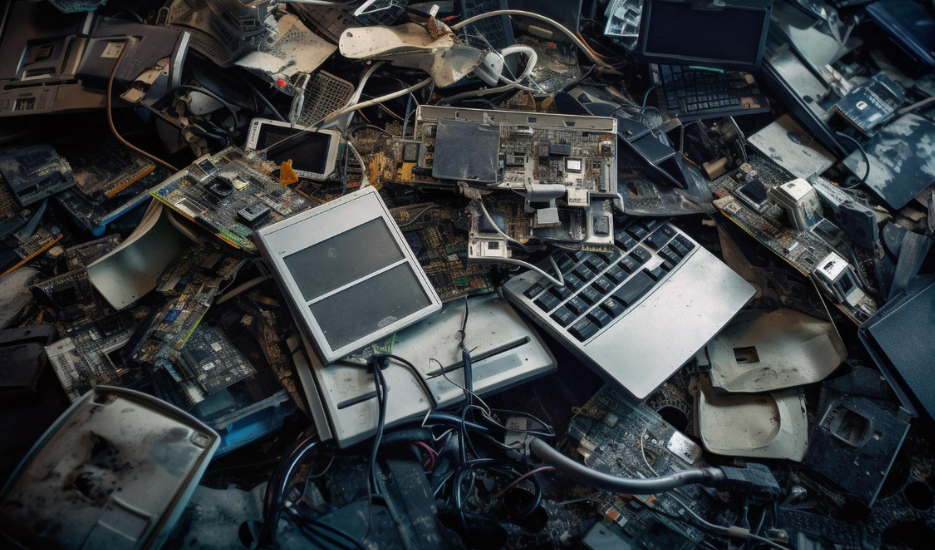
Why Secure IT Asset Disposal Matters
Disposing of IT equipment carelessly exposes your business to two regulators at once:
- Data risk – research repeatedly shows a significant share of second-hand hard drives still hold recoverable data from their previous owner. Under UK GDPR and the Data Protection Act 2018, that’s a breach
- Environmental risk – IT equipment is classed as Waste Electrical and Electronic Equipment (WEEE). Skipping it into general waste or using an uncertified operator is a criminal offence enforced by the Environment Agency
- Financial risk – GDPR penalties can reach up to £17.5 million or 4% of global turnover
What IT Equipment Needs Secure Disposal?
- Laptops, desktops and servers
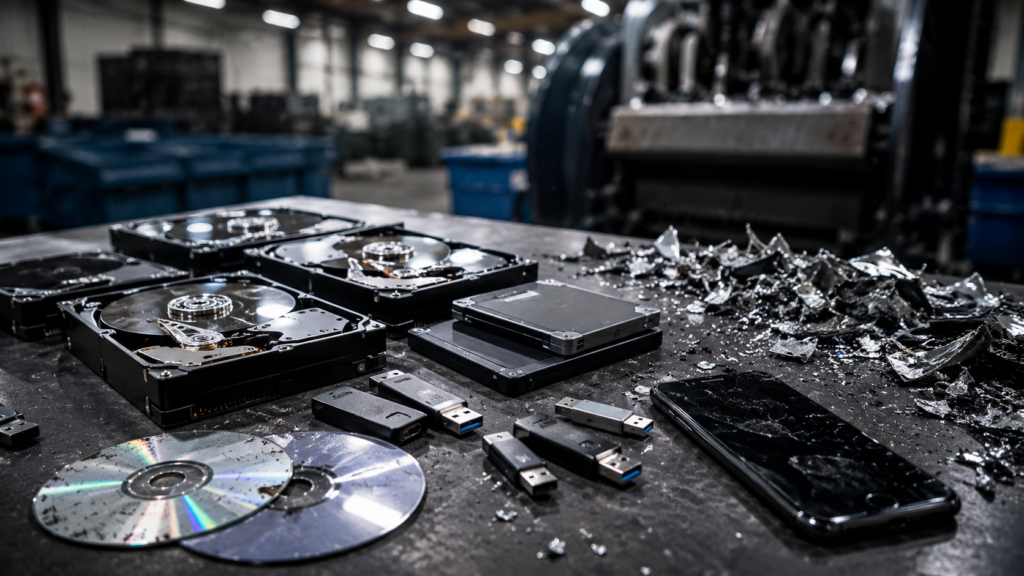
- Hard drives, SSDs, USB sticks and memory cards
- Monitors, printers and networking hardware
- Mobile phones and tablets
- CDs, DVDs and other data-bearing media
Any device that has stored data is a data-bearing device – and must be sanitised or destroyed before disposal.
The UK Laws That Apply to IT Asset Disposal
- UK GDPR & Data Protection Act 2018 – personal data on retired devices must be made permanently unrecoverable, and you must keep evidence
- WEEE Regulations 2013 – business e-waste must be processed by an Approved Authorised Treatment Facility (AATF), which issues WEEE Evidence Notes
- Duty of care – waste must go to a licensed carrier, with waste transfer notes kept for a minimum of two years
- ISO standards – certified providers typically align to ISO 27001, ISO 9001 and ISO 14001
How the IT Asset Disposal Process Works
- Audit & inventory – every asset is logged before collection
- Secure collection – equipment is collected under a documented chain of custody
- Data destruction – drives are wiped to a recognised standard or physically destroyed
- Certification – a Certificate of Destruction is issued, ideally listing device serial numbers
- Recycling – remaining materials are recycled responsibly via an AATF
What Documents Should a Certified Provider Give You?
A compliant IT asset disposal provider should supply, as standard:
- Certificate of Destruction – confirming the method and the devices destroyed
- Waste Transfer Note – confirming transfer to a licensed carrier
- WEEE Evidence Note – issued by the AATF
- Asset audit report – reconciling every device collected against every device processed
If a provider can’t give you all of these, they aren’t providing a compliant service.
How Total Shred Handles IT Asset Disposal
Total Shred delivers secure, certified IT equipment disposal to BS EN 15713, ISO 9001 and ISO 14001 standards. We collect your end-of-life equipment under a secure chain of custody, destroy hard drives and data-bearing media beyond recovery, and issue a Certificate of Destruction on completion – with 100% recycling of processed material. From a single old laptop to a full server-room clear-out, we keep your data safe and your business compliant.
Frequently Asked Questions
Q1. What is IT asset disposal (ITAD)?
IT asset disposal is the structured, compliant process of retiring, sanitising and responsibly disposing of end-of-life IT equipment such as laptops, servers and hard drives. Unlike standard recycling, it includes certified data destruction, a documented chain of custody, a Certificate of Destruction, and WEEE-compliant recycling.
Q2. Why is secure IT asset disposal important?
Because retired devices still hold recoverable data and are classed as hazardous e-waste. Improper disposal can breach UK GDPR and the WEEE Regulations simultaneously, exposing your business to ICO fines, Environment Agency enforcement, and reputational damage. Secure IT asset disposal removes both risks.
Q3. Is IT asset disposal a legal requirement in the UK?
Yes. Under UK GDPR and the Data Protection Act 2018 you must ensure personal data on retired devices is permanently destroyed, and under the WEEE Regulations 2013 your e-waste must be processed by an Approved Authorised Treatment Facility. Both apply at the same time.
Q4. What’s the difference between IT asset disposal and recycling?
Standard recycling deals only with the physical material. IT asset disposal adds certified data destruction, a documented chain of custody, individual Certificates of Destruction, and a full audit trail – the data security and legal evidence UK businesses need under GDPR and duty of care.
Q5. Do I get a certificate when disposing of IT assets?
Yes. A compliant provider issues a Certificate of Destruction confirming the method used and the devices destroyed, ideally listing serial numbers. This is your legal evidence of compliant disposal and should be retained against your asset register, often for several years.
Q6. What IT equipment can be disposed of through ITAD?
Laptops, desktops, servers, hard drives, SSDs, USB sticks, monitors, printers, networking hardware, mobile phones, tablets, and storage media such as CDs and DVDs. Any data-bearing device must be securely sanitised or destroyed before disposal.
Q7. How should hard drives be destroyed during IT asset disposal?
Hard drives should be wiped to a recognised data sanitisation standard or physically destroyed (shredding or degaussing), depending on the data’s sensitivity. Your provider should issue serial-number-level Certificates of Destruction, not a single batch certificate, as proof.
Q8. How long should I keep IT asset disposal records?
Waste transfer notes must be kept for a minimum of two years under duty of care rules, while GDPR records of data destruction are typically retained for several years – often up to six for regulated industries – to support audit and compliance.
Dispose of Your IT Assets Securely
Don’t let old laptops and hard drives become a data breach waiting to happen. Total Shred delivers certified, GDPR and WEEE-compliant IT asset disposal – with secure data destruction, a Certificate of Destruction, and 100% recycling. Get a tailored quote today, or call 0800 298 4009 to discuss your requirements.