
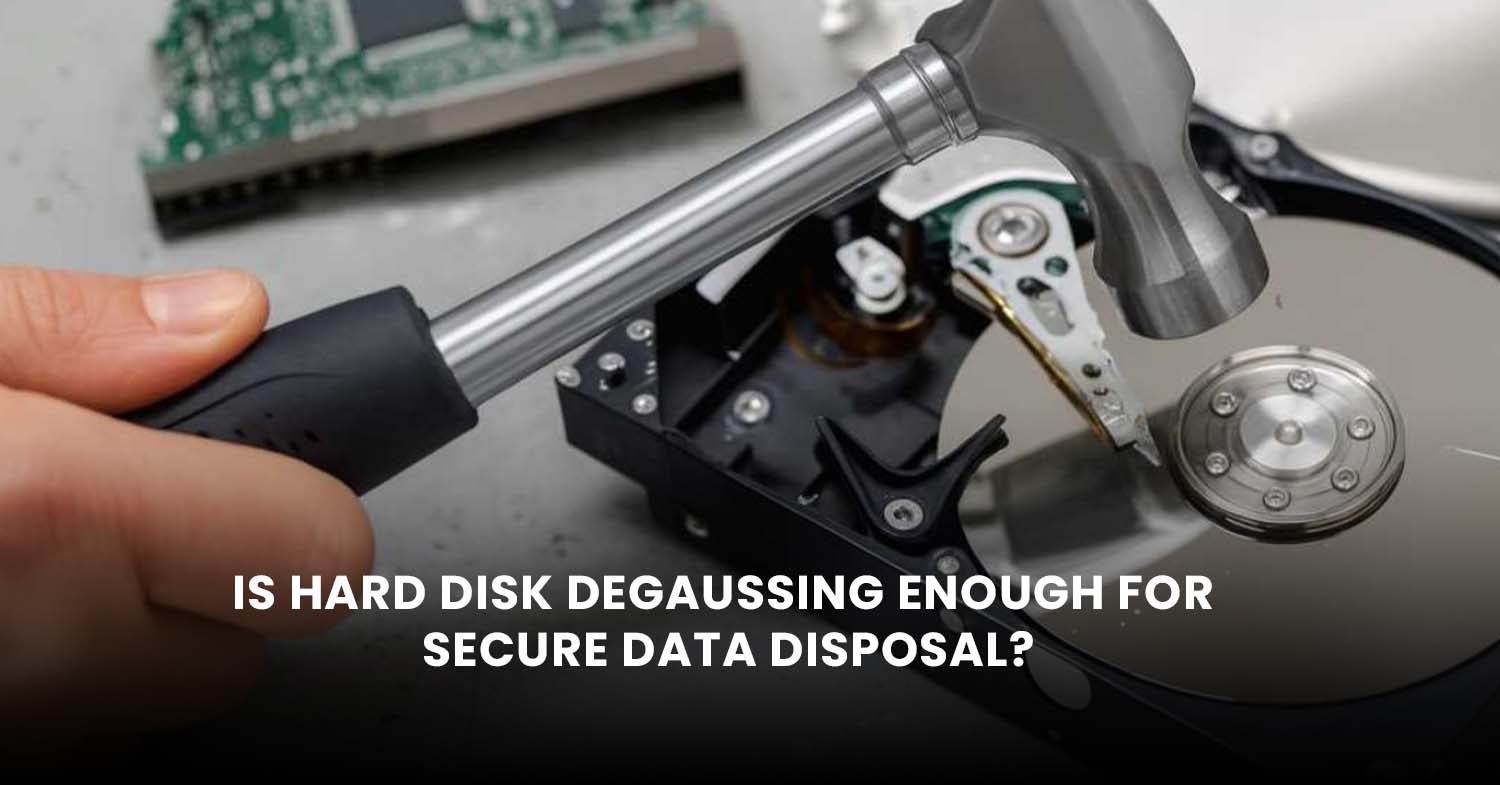

Degaussing is a reliable way to erase traditional hard drives and backup tapes, but it has no effect on SSDs, USB sticks or phones. Because most modern laptops now use SSDs, degaussing on its own is rarely enough. For secure hard drive disposal, most UK businesses degauss their magnetic drives and then shred them, which also lets them show that the data is gone for good.
What Is Hard Disk Degaussing and How Does It Work?
The science behind degaussing
A hard drive stores data as tiny magnetised areas on spinning metal platters. Degaussing uses a very strong magnetic field to scramble those areas, so the data cannot be read or recovered, even in a lab.
It also wipes the factory settings the drive needs to run. A degaussed hard drive looks the same on the outside, but it will never work again.
Understanding the Science Behind Hard Disk Degaussing
Hard disk degaussing is the process of erasing data by exposing a magnetic storage device to an extremely powerful magnetic field. Traditional hard drives store data magnetically, meaning every bit of information is represented by magnetic orientation on the disk’s platter. Degaussing neutralises this orientation, effectively destroying the data pattern and making recovery impossible.
Companies like Total Shred, which specialise in hard drive destruction in the UK, often use certified degaussing equipment that meets international standards. The science is simple but powerful — once the drive’s magnetic field is disrupted, no software or hardware recovery tool can retrieve the data. This makes it an effective choice for businesses dealing with confidential or classified information.
How degaussing erases data, step by step
- Each drive’s serial number is recorded.
- The drive is placed in the degausser and exposed to the magnetic field for a few seconds.
- The drive is logged as complete, ready for shredding and the certificate of destruction.
Types of degaussing equipment
Coil degaussers create a steady magnetic field and suit smaller volumes. Capacitor-discharge degaussers release one very powerful pulse and are better for modern, high-capacity drives. Always ask your provider which type they use.
Why do businesses choose hard disk degaussing?
Companies handle sensitive data every day, making secure disposal essential. Degaussing ensures total erasure of information without the risk of recovery, protecting businesses from data breaches and fines.
Many organisations in the UK choose Total Shred for their hard drive destruction and IT disposal in the UK because it’s quick, cost-effective, and environmentally friendly.
Complete erasure, not just deletion
Deleting or formatting a drive only hides the files, and free software can often bring them back. Degaussing removes the data completely from every part of the platter.
Speed and cost
A degausser can erase a drive in seconds, which makes it practical for large office clear-outs and data centre upgrades. It can be done on-site or at a secure facility.
Environmental benefits
Once the data is gone, the drive’s metal and plastic can be recycled safely under UK WEEE rules. See our guide to electronic waste disposal and recycling.
What Are the Limitations of Hard Disk Degaussing?
When degaussing is not enough
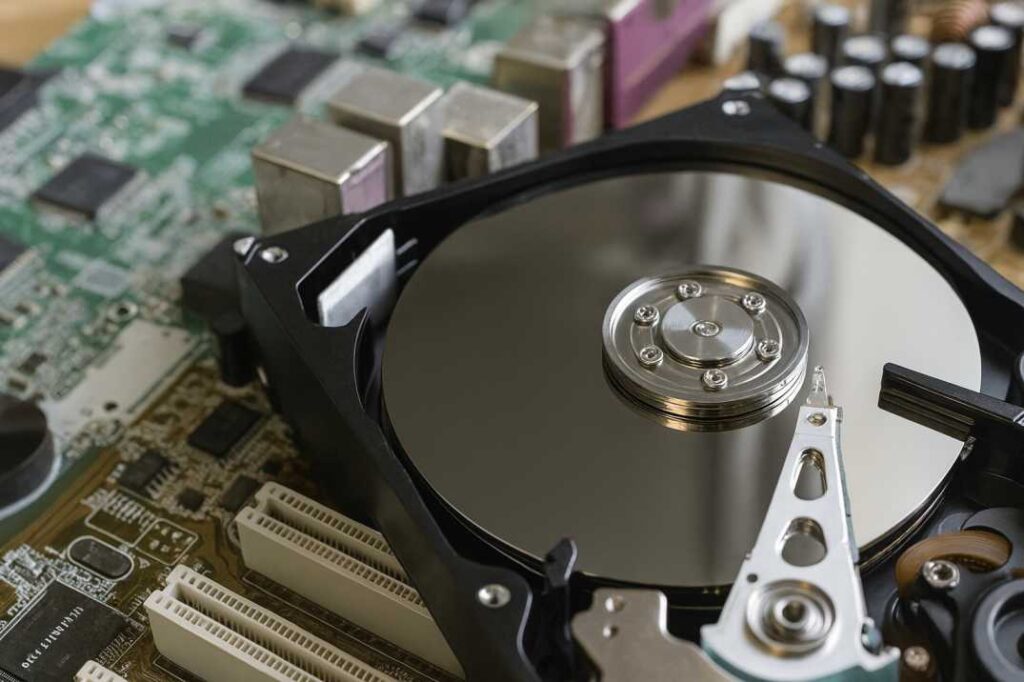
You cannot see that it worked. A degaussed drive looks exactly like a working one, which makes it hard to prove to an auditor. Hybrid drives are a further risk, because some combine magnetic platters with a small flash memory chip, and degaussing only erases the magnetic part.
SSDs and modern devices
SSDs store data in electronic memory chips instead of magnetic platters, so a magnet has no effect on them. Here is which method works on which device:
- Hard drive (HDD): degaussing works, data wiping works, shredding works.
- Backup tape: degaussing works, wiping is not usually possible, shredding works.
- SSD (most modern laptops): degaussing does not work, wiping works only with SSD-specific software, shredding works.
- USB stick or memory card: degaussing does not work, wiping is not reliable, shredding works.
- Phone or tablet: degaussing does not work, a factory reset is not enough, shredding works.
Low-quality or outdated degaussers
Modern hard drives store data very densely and need more magnetic force to erase. An old or underpowered machine can leave data behind.
Are there better or complementary alternatives?
No single method guarantees total data protection. Combining degaussing with physical destruction—like shredding or crushing—offers the best results.
Total Shred professional shredding service in the UK ensures all types of drives are completely destroyed, preventing any chance of data recovery.
Physical destruction
Hard drive shredding cuts drives into small fragments, so nothing is left that is large enough to read. It works on every type of storage, including SSDs, USB sticks and phones. Smashing or drilling a drive by hand is not the same, as our guide to the risks of DIY hard drive destruction explains.
Data wiping software
Certified wiping software overwrites the whole drive. It is slower than degaussing, but it is the only option if you want to reuse a device, and it works on SSDs when you use the right software.
Degaussing vs physical destruction: which is more secure?
Both are secure on a hard drive, but only shredding works on every device and gives visible proof. Combining the two covers the weaknesses of each.
How to choose the right disposal method
Key factors to consider
- Only old hard drives or tapes? Degaussing is effective, but shredding afterwards gives you visible proof.
- Laptops with SSDs? Skip degaussing. Use certified wiping if you want to reuse them, or shredding if you don’t.
- Mixed equipment or sensitive data? Degauss the magnetic drives, then shred everything.
- Clearing a whole office? Use a full IT equipment disposal service so that collection, destruction and recycling are handled together.
Industry requirements
Finance, healthcare, legal and public sector organisations usually require drives to be both degaussed and shredded, because their data is highly sensitive and their audits are strict. The NCSC’s guidance on secure sanitisation of storage media is a useful reference.
GDPR and data protection
Under UK GDPR, your business must keep personal data secure for as long as it holds it, including data on old drives in a cupboard. If a drive is lost, sold or recycled with readable data on it, that can count as a data breach. The ICO’s guide to data security explains what is expected.
To protect your business, make sure you have:
- A certificate of destruction that lists each drive’s serial number, the date and the method used
- A record of who collected the drives and where they were taken
- A provider that follows UK guidance on secure data sanitisation
Read more in our guide to GDPR and shredding certifications.
Is hard disk degaussing secure in 2026?
Long-term reliability
Degaussing still works well on hard drives and tapes. But as more businesses move to SSDs, it covers a smaller share of the devices they need to dispose of each year.
When to combine degaussing with shredding
Combine the two whenever data is sensitive or your equipment is mixed. Degaussing erases the magnetic data, and shredding destroys the drive, including any flash memory, in a way anyone can see. Our hard drive destruction service handles both steps, and every drive is logged by serial number.
Final thoughts: choosing a secure hard drive disposal strategy
Degaussing is effective, but it should not be your only line of defence. For secure hard drive disposal, degauss magnetic drives, shred all storage devices and keep a certificate of destruction on file.
Related post: Computer and Laptop Recycling UK: Step by Step Guide
Total Shred offers secure hard drive degaussing and shredding for businesses across London and the South East, with a certificate of destruction for every job.
Get a quote or call 0800 298 4009.
FAQs About Commercial Document Shredding
What is hard disk degaussing?
Hard disk degaussing is a process that uses a powerful magnetic field to erase all data stored on a magnetic hard drive or tape. The magnetic force randomizes the magnetic domains on the disk platters, making the data permanently unreadable and irrecoverable.
Is degaussing better than deleting or formatting a hard drive?
Yes. Deleting or formatting a drive only removes file directories, not the actual data. That data can often be recovered with software tools. Degaussing, on the other hand, completely destroys the magnetic structure of the drive, ensuring total and irreversible data erasure.
Does degaussing work on SSDs (solid-state drives)?
No. Degaussing only works on magnetic storage like traditional hard drives and tapes. SSDs use electronic storage, so they must be wiped using data erasure software or physically destroyed by a professional shredding service in the UK like Total Shred.
Can a degaussed hard drive be reused?
Typically, no. After degaussing, the drive’s magnetic components and firmware become permanently damaged. The drive cannot be reformatted or reused and is considered non-functional. It should be recycled through an IT disposal in the UK service for environmental compliance.
Why should I use a professional shredding service instead of DIY methods?
DIY methods like hammering or drilling are risky and often fail to fully destroy data. A professional shredding service in the UK, such as Total Shred, provides certified destruction, proof of disposal, and ensures full GDPR compliance — giving you security and accountability.