

Most UK businesses already accept that they have to shred confidential paperwork. Far fewer have worked out what they get back for the money. The compliance argument is well covered everywhere. The rest of the case tends to go unmentioned until a finance director asks what the invoice is actually buying.
This guide answers that question. It covers what confidential shredding returns to a business in compliance evidence, running costs and recovered staff time, and it goes into detail on the part almost nobody explains properly: what happens to your documents after the van drives away, and whether shredded paper really does get recycled.
If you want the groundwork first, our guide to what confidential shredding is covers the definitions, the security standards and the difference between on-site and off-site collection.
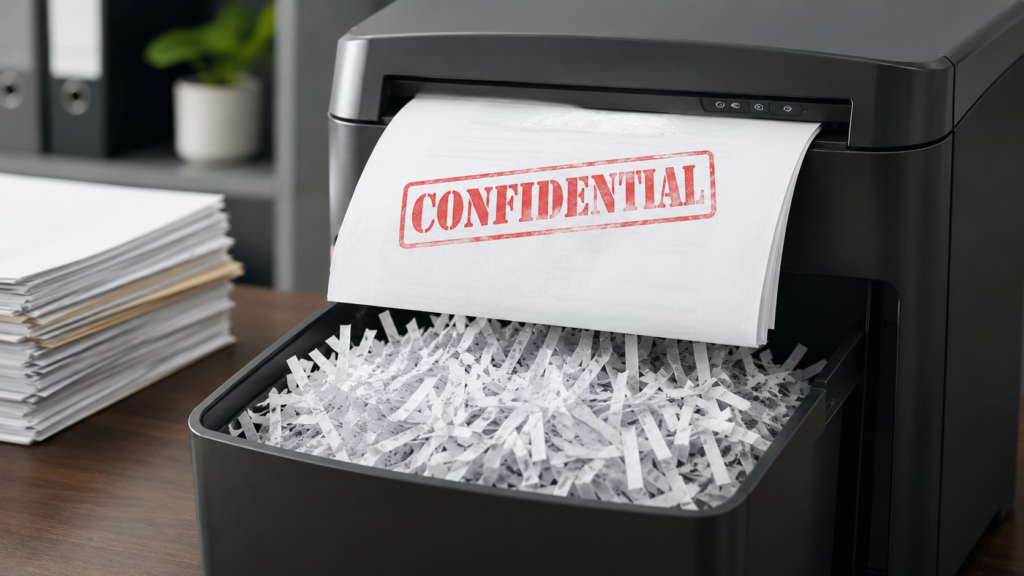
What confidential shredding actually buys you
Confidential shredding is the secure destruction of documents and media holding sensitive information, carried out to a recognised standard so nothing can be pieced back together. That is the mechanism. The value sits in five places:
- Documented evidence that you met your data protection duty
- A lower total cost than running the job in house
- Staff hours returned to work that earns money
- A guaranteed recycling route for every sheet collected
- Figures you can use in environmental and ESG reporting
The first two are why finance signs off. The last one is increasingly why procurement asks about it in the first place.
Compliance you can evidence
Under UK GDPR and the Data Protection Act 2018, you have a duty to dispose of personal data securely. The legislation does not name shredding as the method, which is where a lot of businesses get caught out. They assume that because no specific process is mandated, any reasonable disposal will do.
The problem is not the destruction. It is the proof.
If the Information Commissioner’s Office asks how a batch of customer records was disposed of in March, an office shredder gives you nothing to show. A certified provider gives you a Certificate of Destruction with a date, a job reference and a named standard against it. That document is the difference between demonstrating compliance and asserting it.
This matters beyond the regulator. Insurers ask for it after a claim. Auditors ask for it during ISO reviews. Clients running supplier due diligence ask for it before they sign. A folder of destruction certificates answers all three without anyone having to reconstruct what happened.
Lower cost than shredding in house
An office shredder looks cheap because the only visible number is the purchase price. Count the rest and the comparison changes.
You are paying for the machine, replacement parts when it burns out, waste bags, and the bin collection for whatever comes out of it. Then there is the labour. Someone has to stand there feeding sheets in, removing staples first on most consumer machines, and clearing the jam when it seizes. That person is on your payroll at their hourly rate, doing work that generates nothing.
Professional secure shredding moves that to a fixed, predictable line item. You fill a locked console, it gets emptied on a schedule, and the cost per unit falls as volume rises. Bulk shredding for an archive clear-out or an office move is cheaper per box again, because the whole job happens in one visit.
For an accurate comparison, work out your current shredding hours per month and multiply by the loaded hourly cost of the person doing it. Most businesses find that figure alone covers a scheduled collection.
Staff hours you get back
This benefit gets dismissed as soft, which is a mistake. Shredding is one of those tasks that expands to fill whatever time is available and never appears on anyone’s objectives.
Industrial equipment handles staples, paper clips, plastic wallets and ring binders without pre-sorting. Nobody prepares anything. Documents go into a locked console during the working week, and the console gets emptied without interrupting anybody. The task stops existing rather than getting faster.
What happens to your documents after collection
Here is the part most shredding pages skip in a sentence.
Once your confidential waste is destroyed to the BS EN 15713 standard, the output is no longer a security asset. It is a raw material, and it enters a well established supply chain.
The shredded material is compressed into dense bales. Baling is not cosmetic. Loose shredded paper is bulky, awkward to transport and prone to blowing around, so mills will not take it in that state. Baling makes it economic to move and acceptable at the gate.
Those bales go to a UK paper mill, where the material is pulped. The bales are broken up in water and agitated until the paper separates back into individual fibres, producing a slurry. Contaminants that travelled with it, staples, paper clips, plastic windows from envelopes, are screened out during this stage. That is why you do not need to remove them beforehand.
The cleaned pulp is then pressed and dried into new paper products. Recycled office paper typically becomes newsprint, cardboard packaging, tissue or hand towels rather than fresh office paper, because fibres shorten slightly each time they go through the process.
Can shredded paper be recycled?
Yes. This question comes up constantly, usually because someone has heard that shredded paper is rejected by recycling schemes, which is true in a specific context and false in general.
Cross-cut shredding to EN 15713 shortens paper fibres but does not destroy them. There is more than enough fibre length left for pulping. The material recycles normally.
The confusion comes from kerbside collections, where shredded paper genuinely is a problem. That is a sorting issue, not a fibre issue, and it is covered in the next section.
There is also no data protection reason to avoid recycling confidential waste. Once documents are destroyed to standard, the information cannot be reconstructed, so what remains is simply paper. Recycling it carries no residual risk. The Certificate of Destruction is issued at the point of destruction, before the material is ever baled.
How to dispose of shredded paper without contaminating the load
If you shred in house and put the output in general recycling, there is a reasonable chance it ends up in landfill anyway.
Recycling facilities separate materials using mechanical screens sized for whole sheets and flat card. Shredded strips are too small. They fall through the wrong screens, stick to other materials, jam the sorting equipment, and get classified as contamination. A single bag of loose shreds can downgrade the value of an entire load.
Some councils accept shredded paper if it is bagged in paper sacks rather than loose or in plastic. Rules vary by authority, so check yours rather than assuming.
For business volumes, the reliable route is a confidential waste collection that keeps your material segregated from start to finish. It gets destroyed, baled and delivered to a mill as a single clean stream, so all of it is recycled rather than most of it being sorted out.
Sustainability figures you can put in a report
Environmental reporting has moved from optional to expected, particularly for anyone bidding into public sector frameworks or supplying larger corporates.
A provider certified to ISO 14001 operates a documented environmental management system, which means the recycling claim is auditable rather than marketing. Total Shred also holds ISO 9001 for quality management. Both certifications, along with the recycling tonnage figures behind your account, can go directly into your environmental reporting, CSR statements and tender responses.
That turns a compliance cost into something that supports revenue. You can read more about our approach on our corporate social responsibility page.
Confidential shredding with Total Shred
Total Shred provides certified confidential shredding across the UK, including London and Glasgow, for businesses of every size.
Our service covers on-site mobile shredding at your premises where you want to witness destruction, and secure off-site collection where volume or cost makes that the better fit. We handle one-off clear-outs and scheduled collections, paper records and hard drives and digital media, plus ID cards, branded stock and archived files.
Every job is destroyed to BS EN 15713, carried out by uniformed and security vetted staff, backed by a Certificate of Destruction, and followed by 100% recycling of the material collected.
Request a quote with your rough volumes and collection frequency, and we will give you a figure you can compare against what shredding currently costs you.
Frequently asked questions
Can shredded paper be recycled?
Yes. Cross-cut shredding to EN 15713 shortens the fibres but leaves them long enough to pulp normally. Total Shred bales all shredded material and sends it to a UK paper mill, where it is reprocessed into new paper products.
Can you recycle shredded documents that contained personal data?
Yes, and it is the standard route. Once documents are destroyed to EN 15713 the data cannot be reconstructed, so the remaining material is just paper. Your Certificate of Destruction is issued at destruction, before the material moves on for recycling.
How should a business dispose of shredded paper?
Not through general recycling. Loose shreds fall through sorting screens at recycling facilities and are treated as contamination, which can send the whole load to landfill. A confidential waste collection keeps the material segregated and baled so all of it reaches a mill.
Where can I shred papers for free in the UK?
Some councils and community groups run free shredding events for households. They do not issue a Certificate of Destruction. For business records that is a compliance gap, because you need documented proof of disposal rather than just disposal itself. Free events are fine for personal post and old bank statements at home.
Is confidential shredding cheaper than shredding in house?
Usually, once the full cost is counted. An office shredder carries a purchase price, maintenance, consumables, waste collection and staff hours. A scheduled service is a fixed cost per collection with no labour attached, and the per-unit price falls as volume increases.
Does confidential shredding count towards our sustainability reporting?
Yes. A provider certified to ISO 14001 can supply recycling figures alongside your Certificate of Destruction, and both feed directly into environmental reporting, CSR statements and tender submissions.