

If you run a business in the UK, your recycling bins aren’t just bins; they’re potential security risks. Every piece of paper, every old hard drive, and every discarded uniform holds information that could lead to financial disaster or crippling GDPR fines. Managing confidential waste disposal is not an optional chore; it is a critical, legal responsibility.
This comprehensive guide is designed for UK business owners, managers, and compliance officers. We will walk you through essential tips and best practices for secure confidential waste disposal, ensuring you meet strict UK regulations, protect client data, and maintain a robust audit trail. Mastering this process with Total Shred is key to preventing breaches and safeguarding your company’s future.
Tip 1: Establish a Clear 'Shred-All' Policy for Paper
The most fundamental step in secure confidential waste disposal is eliminating guesswork. Employees should never be left to decide whether a document is sensitive enough to shred. Confusion leads to risk.
Implementing Secure Paper Collection Containers
The first step in proper confidential waste disposal is to implement lockable, secure consoles or bins throughout your office. These containers must be clearly labelled and accessible to all staff.
Your policy must mandate that all paper should be placed into these secure units, regardless of perceived sensitivity. This simple, easy-to-follow “Shred-All” rule vastly reduces the risk of confidential documents accidentally landing in general waste or recycling bins. The containers serve as the first link in a guaranteed, secure chain of custody.
Training Staff on Retention Periods
Part of effective confidential waste disposal involves knowing when to destroy documents. Documents must be kept for their mandatory retention period (e.g., HMRC tax records), but destroying them too early, or keeping them too late, is risky.
Train your staff on which documents have met their retention deadline. This ensures the secure containers are filled with disposable material, preventing massive backlogs and managing your compliance with the GDPR’s Storage Limitation Principle.
Tip 2: Prioritize Compliance with UK Law (GDPR and BS EN 15713)
When dealing with confidential waste disposal, compliance is king. Ignoring or underestimating the severity of UK data protection laws is the fastest route to massive fines and reputational collapse.
Understanding the Legal Imperative of GDPR
The UK General Data Protection Regulation (GDPR) dictates how all personal data must be handled, and its scope includes destruction. If you fail to destroy paper waste securely, you violate the principle requiring appropriate technical and organisational measures to ensure security. This makes the proper process essential to compliant confidential waste disposal.
It is crucial to understand why data destruction is important for your business beyond simply obeying the law; it’s about mitigating existential risk.
Insisting on the BS EN 15713 Standard
For confidential waste disposal to be truly secure and auditable, your service provider must adhere to the BS EN 15713 standard. This British and European standard outlines the strict requirements for the secure destruction of confidential material. It covers everything:
- Staff background checks and vetting.
- Security of vehicles and facilities.
- The destruction process itself (cross-cut or particle-cut).
If your provider is not certified to this standard, your audit trail may be deemed insufficient, rendering your entire confidential waste disposal process vulnerable.
Tip 3: Always Demand a Certificate of Destruction
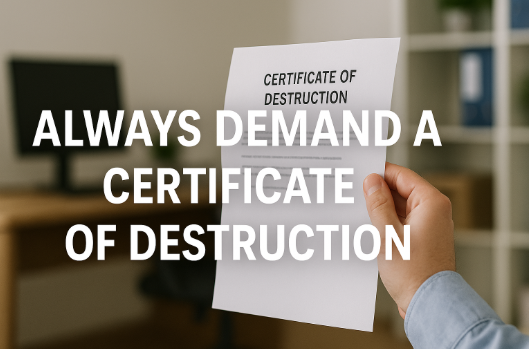
In the event of a security audit or legal challenge, trust is irrelevant; only proof matters. The Certificate of Destruction (CoD) is the single most important document in your confidential waste disposal process.
The Auditable Paper Trail
A CoD, issued after every service by a professional provider, serves as your verifiable evidence that data destruction has occurred. It formally transfers the legal responsibility for the data from your business to the shredding company at the moment of destruction.
The certificate should explicitly detail:
- The date and time of the destruction.
- The volume or weight of materials destroyed.
- The method used (e.g., on-site cross-cut shredding).
- A formal statement confirming adherence to BS EN 15713.
Keep these certificates filed securely. They are your primary defence against claims of negligence regarding confidential waste disposal.
Ensuring the Chain of Custody
The Certificate of Destruction is underpinned by the chain of custody. This is a documented process that tracks your confidential waste from the secure console in your office to the final point of destruction. Using a professional service ensures this chain is unbroken, documented, and performed by vetted, uniformed personnel in GPS-tracked vehicles. This rigour is the foundation of secure confidential waste disposal.
Tip 4: Don't Forget Secure IT and Media Destruction
Paper is only half the battle. One of the biggest mistakes UK businesses make is assuming that deleting files or using a hammer is adequate for old electronics. Secure confidential waste disposal must include digital media.
Physical Destruction of Hard Drives and Storage Media
Hard drives (HDDs and SSDs), backup tapes, USB sticks, and optical media (CDs/DVDs) all contain recoverable confidential data, even after being wiped or reformatted. Secure destruction requires the media to be physically destroyed, typically through industrial shredding or crushing.
Before sending any equipment for recycling, you must know how to dispose of hard drives securely before recycling. Only physical destruction renders the data truly inaccessible.
The Role of IT Asset Disposal (ITAD)
For businesses decommissioning multiple devices, a full IT Asset Disposal (ITAD) service is essential. This goes beyond simple confidential waste disposal. ITAD includes:
- Inventory and tracking of all assets.
- Certified data wiping or physical destruction.
- WEEE-compliant environmental recycling of the remaining carcass.
This complete service ensures that both data and equipment are handled legally and securely, answering the fundamental question: what is IT asset disposal and why is it essential for your business?
Tip 5: Integrate Environmental Compliance (WEEE)
Your responsibility for confidential waste disposal extends to the environment. UK law dictates how electronic waste must be managed, regardless of whether the data has been destroyed.
Adhering to WEEE Regulations
The Waste Electrical and Electronic Equipment (WEEE) Regulations require that electronic waste be separated and treated appropriately. Throwing e-waste, which contains hazardous materials like lead and mercury, into general landfill bins is illegal and environmentally harmful. This makes WEEE compliance a non-negotiable part of confidential waste disposal when dealing with electronics.
Partnering with a professional ITAD or shredding company that offers certified IT equipment disposal services ensures you remain compliant with these strict UK environmental laws.
Ensuring Paper is Recycled Correctly
Just as digital waste has specific rules, so does paper. Professional shredding services guarantee that 100% of your shredded paper waste is baled and recycled at accredited UK paper mills. This contrasts sharply with in-house shredded paper, which often gets rejected by standard council recycling services due to its small particle size.
By choosing a certified service, you not only protect data but actively demonstrate environmental responsibility, a key part of modern corporate governance. You can read more about how we recycle confidential paper waste to understand the positive impact.
Tip 6: Choose the Right Service Schedule for Your Business Needs

Efficiency in confidential waste disposal comes down to timing and logistics. A scheduled, reliable service is always better than relying on ad-hoc clear-outs.
Setting Up a Regular Collection Service
Establishing a fixed schedule, whether weekly, fortnightly, or monthly, is critical. This prevents document build-up, which is a significant security risk. When paper piles up, the temptation to use a desk shredder or even skip shredding altogether increases. Regular confidential waste disposal collections maintain a high level of security discipline across the company.
Matching Service Type to Volume and Security
The best disposal method depends on your business size and security requirements:
- On-Site Shredding: Ideal for the highest security needs where witnessing the destruction is mandatory. The shredding vehicle comes to your premises.
- Off-Site Shredding: More cost-effective for high-volume, regular disposal. Documents are transported in secure, tracked vehicles to a secure central facility.
For medium and large businesses, this decision is strategic. You should determine which shredding services are best for medium and large businesses based on volume and budget.
Tip 7: Recognize When to Outsource (The Final Check)

The single most valuable tip for confidential waste disposal is recognizing that professional shredding is an investment in risk mitigation, not a disposable expense. In-house shredding always carries hidden costs and risks that outweigh any potential savings.
Avoiding the Hidden Costs of DIY Shredding
The supposed savings of in-house shredding quickly vanish when you account for:
- Lost Staff Productivity: High-paid staff manually feeding documents.
- Equipment Costs: Purchasing, maintaining, and replacing jamming shredders.
- Compliance Risk: The lack of a CoD leaves you exposed to GDPR fines.
There are compelling 10 reasons to use a professional shredding service that clearly demonstrate the superior security, efficiency, and compliance offered by experts.
Ensuring Full Media and IT Asset Security
Finally, true confidential waste disposal covers all assets. Ensure your provider offers certified destruction not only for paper but also for digital media. If you are decommissioning any IT equipment, including servers or mobile phones, you must treat the destruction process with the same, if not greater, rigor as paper. Remember that why it’s important to dispose of e-waste properly applies to all your defunct equipment.
Conclusion: Making Confidential Waste Disposal Your Strength
Secure confidential waste disposal should be a source of strength, not a point of vulnerability, for your UK business. By implementing a strict ‘Shred-All’ policy, demanding BS EN 15713 compliance, insisting on a Certificate of Destruction, and securing both paper and digital media, you elevate your data governance to a professional standard.
Embracing these tips transforms a risky chore into a streamlined, compliant, and auditable process. Choose a certified partner to protect your reputation, satisfy regulatory bodies, and safeguard your future. To learn more about secure disposal solutions, visit Total Shred.
FAQs About Commercial Document Shredding
What happens to the paper after confidential waste disposal?
After certified destruction, 100% of the shredded paper is baled and securely transported to UK paper mills where it is recycled into new paper products, supporting the circular economy.
How can I prove my confidential waste disposal is GDPR compliant?
You prove compliance by obtaining a legally binding Certificate of Destruction after every shredding service. This document confirms the secure, audited disposal of your records, satisfying the ICO’s requirements.
What is the most secure method of confidential waste disposal?
The most secure method is professional cross-cut shredding performed by a company certified to the BS EN 15713 standard. This ensures the destruction is physically irrecoverable and legally auditable, backed by a secure chain of custody.
Does confidential waste disposal cover uniforms or branded items?
Yes, many professional services offer secure destruction for branded items, uniforms, and ID badges. This prevents counterfeit goods or impersonation based on your company’s proprietary assets.
How often should I schedule confidential waste disposal collections?
For most businesses, scheduling collections weekly or bi-weekly is best. Regular collections prevent the build-up of sensitive documents, maintain staff discipline, and reduce security risk immediately.