

Bulk shredding is the secure destruction of large quantities of paper records in a single operation, typically fifty archive boxes upward to full pallet loads. It differs from routine office shredding in scale and method: the volumes involved make desktop machines impractical and require industrial equipment, purpose-built vehicles and a documented chain of custody.
Total Shred has carried out bulk document shredding across London and the UK for over fifteen years, and the practical sections below draw on how these jobs run.
What bulk shredding means
There is no single legal definition, though the industry applies the term above the point where volume changes the nature of the job.
A standard office shredder processes six to twenty sheets per pass and needs a cooling interval every few minutes. At that rate a single archive box, holding roughly 2,500 sheets, represents several hours of work. Two hundred boxes becomes a project measured in weeks.
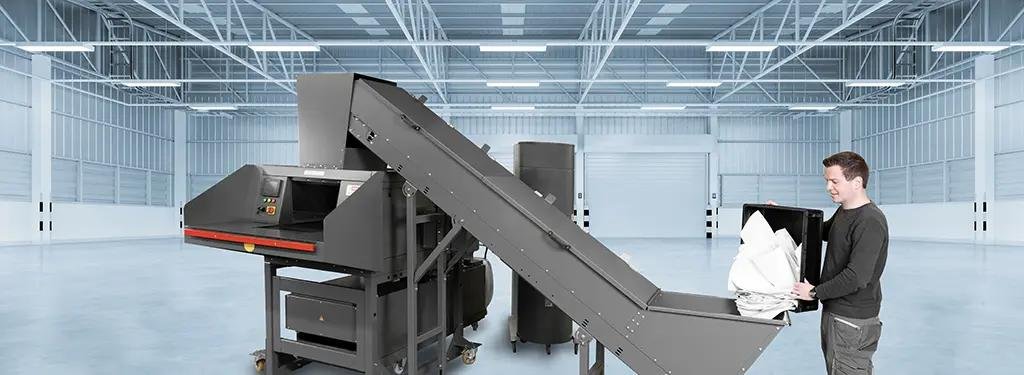
Industrial equipment operates differently. A mobile shredding vehicle destroys around 2,000 to 4,000 kilograms of paper per hour, while static facility shredders handle considerably more. The same two hundred boxes take an afternoon.
That throughput gap is what separates bulk work from routine collection, and why the two are priced on different models.
Why organisations shred in bulk
Large volume shredding is usually triggered by an event rather than a schedule.
Retention periods expiring accounts for a substantial share, since a periodic review tends to surface years of accumulated material at once. Premises changes account for another, as office relocations, lease breaks and downsizing all force decisions about what physically moves, and archive material is frequently the largest category left behind.
Digitisation projects produce clearances of their own. Once paper records have been scanned, indexed and verified, the physical originals become redundant, and scanning bureaux often return a warehouse of boxes that no longer serve a purpose. Mergers and acquisitions have a similar effect, since consolidating two record-keeping systems leaves a superseded duplicate set.
Storage cost drives some clearances directly, given that commercial archive storage is charged per box per month regardless of whether the records are still needed. Business closure produces the largest jobs of all, covering the entire life of an organisation in a single operation.
How much does bulk shredding cost
Commercial shredding cost is calculated on volume rather than time. Shredding companies quote per box, per kilogram, or as a fixed project price, with the per-unit rate falling as volume rises.
That relationship exists because the fixed elements of any job, sending a vehicle, staffing a crew, travelling to site, are broadly the same whether ten boxes or three hundred are collected. Spreading those costs across more material reduces what each box carries.
Volume is the dominant variable, with rates typically stepping down at thresholds around fifty, one hundred and two hundred and fifty boxes. Destruction method matters next: on-site costs more per unit, since a vehicle and operator remain committed to one location for the duration, while facility equipment processes considerably higher throughput.
Access difficulty adds labour time, and upper floors without lift access, restricted stairwells, long carry distances and city-centre parking restrictions all register in the quote. Distance forms part of every price, though its proportional weight falls as volume rises, which is why large jobs further afield remain viable. Material condition matters too, since boxed material processes fastest while loose paper and files still in cabinets increase handling time. Security level completes the picture, as higher DIN levels produce smaller particles, reducing throughput and raising cost per unit.
How volume is measured
Accurate estimates matter because volume drives the quote, and the industry works to a few standard measures.
A standard archive box, roughly 380mm by 290mm by 260mm, holds approximately 2,500 to 3,000 sheets and weighs 15 to 20kg when full. A linear metre of shelving holds around 8,000 to 10,000 sheets, which equates to roughly three archive boxes. A four-drawer filing cabinet is broadly equivalent to four to six boxes when full, and a standard pallet typically carries 30 to 40 boxes weighing 500 to 700kg in total.
Self-estimates are commonly understated by a third or more, largely because material stored on high shelving or behind other items gets overlooked during a rough count.
On-site and off-site methods
Both approaches produce the same result. The distinction is where destruction physically occurs.
On-site shredding brings a mobile vehicle to the premises, where material is destroyed inside the vehicle so that confidential documents never leave the site in readable form. The vehicle carries an industrial shredder, a hopper and a storage compartment for shredded output, and many are fitted with external monitors so the process can be observed from outside. Throughput is lower than facility equipment because a vehicle-mounted shredder is constrained by size and power, so large volumes take longer. This method suits organisations where witnessing destruction matters, whether for internal policy, client assurance or the nature of the material itself.
Off-site shredding collects material in secure GPS-tracked vehicles for destruction at a processing facility using static industrial equipment. Collection involves lockable containers or sealed vehicles and a documented transfer at each stage of the chain of custody, with facilities generally operating continuous CCTV coverage and restricted access. Static shredders process substantially more material per hour than mobile units, which makes this the more economical route at scale, and turnaround is usually faster overall despite the additional transport stage.
Total Shred operates both, so the choice comes down to the material and the circumstances rather than what happens to be available.
Shred sizes and DIN security levels
Paper destruction is classified under DIN 66399, which replaced the earlier DIN 32757 standard in 2012. It defines seven security levels for paper media, designated P-1 through P-7, based on the maximum particle size produced.
The lower levels cover material of limited sensitivity. P-1 permits particles up to 2,000mm² and suits general non-sensitive printed material, while P-2 tightens that to 800mm² for internal documents. P-3, at 320mm², covers material carrying some degree of confidentiality.
The middle levels are where most commercial work sits. P-4 permits particles no larger than 160mm² and is the practical standard for personal data and confidential business records. P-5 reduces that to 30mm², appropriate for sensitive information where disclosure would cause serious harm.
The highest levels are rarely encountered outside government work. P-6 permits 10mm² and P-7 just 5mm², reserved for classified material and national security applications respectively.
Cutting method determines which level a machine reaches. Strip-cut shredding produces long ribbons by cutting in one direction and generally achieves P-1 or P-2. Cross-cut shredding cuts in two directions to produce rectangular particles, typically reaching P-3 to P-5, and is standard for confidential material.
The distinction most organisations encounter is between P-4 and P-5. P-4 makes reconstructing a document impractical rather than merely difficult, while P-5 reduces that to a point generally considered unfeasible.
BS EN 15713, the British Standard for secure destruction, separately specifies a maximum particle width of 15mm for confidential material, alongside requirements covering premises security, staff vetting, transport and record-keeping.
How bulk paper shredding works at Total Shred
Large clearances start with establishing what is actually there. For substantial jobs this usually means a site visit, though clear photographs achieve the same result on straightforward sites. The assessment covers volume verification, the access route including lift and stairwell dimensions, where a shredding vehicle can legally park, whether a council bay suspension is needed, and whether the material includes hard drives or other media requiring separate handling. That produces a fixed price rather than an estimate, which matters on large volumes where an estimate that moves can move considerably.
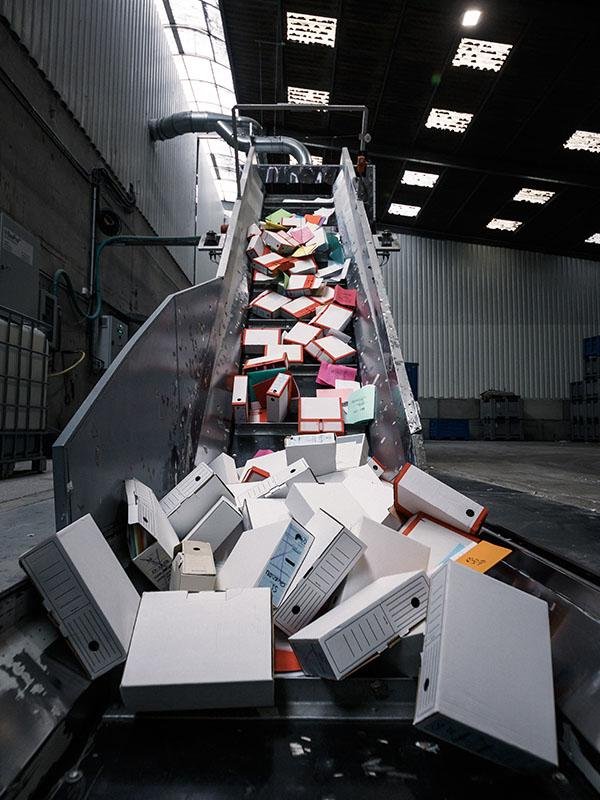
On collection day the crew removes material from wherever it is stored, upper floors included, so nothing needs bringing down to ground level beforehand. On two hundred boxes that represents a meaningful amount of staff time that would otherwise go uncosted. Boxes, loose files and material still in filing cabinets are all handled, and staples, clips, elastic bands, plastic wallets and ring binders stay in place, since industrial cutting mechanisms process them without difficulty and metal is separated magnetically afterwards.
Material is then destroyed to the DIN level appropriate to its sensitivity, with P-4 covering most confidential business records and P-5 available where the material warrants it. A Certificate of Destruction is issued on completion, usually electronically, recording what was destroyed and when. That document is what demonstrates appropriate disposal to an auditor, regulator or insurer, and supports the accountability requirement under Article 5(2) of UK GDPR.
Total Shred operates from Devonshire House, Honeypot Lane, Stanmore, covering London and the Home Counties as standard for high-volume work. Hard drives, backup tapes and other media can be destroyed alongside a paper clearance under the same chain of custody, through the hard drive destruction service.
What happens to the paper afterwards
Shredded office paper is a raw material rather than a waste product. It falls into the higher grades of recovered paper because office stock is generally white, uncoated and relatively free of contamination.
At the mill, bales are pulped in water to separate the fibres. De-inking removes printing inks through flotation or washing, and the resulting pulp is screened, cleaned and formed into new paper products.
Paper fibre can be recycled somewhere between five and seven times before the fibres become too short to bond effectively. Recovered fibre is then blended with virgin pulp or diverted into products where fibre length matters less, such as packaging or moulded fibre. Shredded material sits at a slight disadvantage here, since shredding shortens fibres before the mill even receives them, which is one reason paper destined for destruction is generally not shredded finer than the required security level demands.
All paper Total Shred destroys goes to UK mills, with nothing routed to landfill.
How long confidential documents are typically kept
Bulk clearances usually follow a retention review, and the volumes involved reflect how long records accumulate before disposal becomes appropriate.
Payroll and PAYE records are generally held for three years after the end of the tax year they relate to, while VAT records require six years. Company accounting records need three years for a private company. Personnel files are commonly retained for six years after employment ends, aligning with the limitation period for contractual claims, and accident and health records for three years from the date of the last entry. Records covering exposure to hazardous substances sit at the far end of the scale, requiring forty years under COSHH.
Beyond specific statutory periods, UK GDPR establishes a storage limitation principle, holding that personal data should not be retained for longer than necessary for the purpose it was collected for. That principle is what converts an expired retention period into an active reason to destroy rather than simply permission to.
Requirements vary considerably by sector, and financial services, healthcare, legal practice and education all carry additional obligations beyond these general figures.
Standards that govern paper destruction companies
Several frameworks apply to document shredding services in the UK.
BS EN 15713 is the British and European standard for secure destruction of confidential material, setting requirements that cover premises security, employee vetting, transport, subcontracting arrangements, particle size and the documentation issued on completion. It applies to the whole process rather than the shredding alone. DIN 66399 sits alongside it as the international standard classifying destruction by media type and security level.
ISO 9001 and ISO 14001 address quality management and environmental management respectively, the former covering consistency of process and documented procedures, the latter the environmental impact of operations including waste routing and recycling.
UK GDPR and the Data Protection Act 2018 govern the handling of personal data rather than destruction specifically, though they establish who bears responsibility and what accountability requires. Separately, any organisation transporting waste commercially must register as a waste carrier with the Environment Agency in England, or the equivalent body in Scotland, Wales and Northern Ireland.
Total Shred holds BS EN 15713, ISO 9001 and ISO 14001 certification. Questions about a specific clearance can go to 0203 582 4077 or the contact page.
Frequently asked questions
What is bulk shredding and how much does it cost?
Bulk shredding is the secure destruction of large quantities of paper records in a single operation, generally from around fifty archive boxes upward, using industrial equipment rather than office machines. Cost depends on volume, destruction method, access, distance and security level. Rates are quoted per box, per kilogram or as a fixed project price, with the per-unit rate falling as volume rises, typically stepping down around 50, 100 and 250 boxes.
How is bulk shredding volume estimated?
By box count, linear metres of shelving, filing cabinet count or pallet count. A standard archive box holds 2,500 to 3,000 sheets and weighs 15 to 20kg. A linear metre of shelving equals roughly three boxes, a four-drawer cabinet four to six boxes, and a standard pallet 30 to 40 boxes at 500 to 700kg. Self-estimates are commonly understated by a third or more.
What shred size is used for confidential documents?
Material containing personal data is generally destroyed to DIN 66399 level P-4, producing particles under 160mm². P-5, under 30mm², is used for sensitive information where disclosure would cause serious harm. BS EN 15713 separately specifies a maximum particle width of 15mm. Strip cut reaches P-1 or P-2, while cross cut typically achieves P-3 to P-5 and is standard for confidential material.