

As businesses in the UK handle growing amounts of sensitive data in 2026, secure data destruction has become a critical aspect of both compliance and security. Whether it’s digital information stored on hard drives, cloud accounts, or physical documents like contracts and HR records, improper disposal of data can lead to identity theft, data breaches, and severe legal penalties.
Secure data destruction is more than just discarding old files — it’s a systematic process to permanently erase or destroy data so it cannot be recovered. Leading providers such as Total Shred offer certified Data Destruction in UK, professional shredding services in the UK, and product destruction in UK, ensuring businesses remain fully compliant with GDPR and other regulations.
What Is Secure Data Destruction and Why Does It Matter in 2026?
Secure Data Destruction is the complete, permanent, and irreversible removal of data from its storage medium, guaranteeing that no residual information can be recovered or reconstructed by any known method. Unlike simple deletion or reformatting, which only remove the directory pointer to the file, secure destruction physically or magnetically sanitizes the storage space itself. In 2026, with sophisticated data recovery tools readily available, this absolute assurance of destruction is the only way to meet modern compliance standards.
Importance for Businesses and Individuals
For businesses, secure destruction is a critical strategy for managing data debt—the liability carried by storing data longer than necessary. It is the practical execution of key legal principles, such as the General Data Protection Regulation (GDPR) requirement for data minimisation and the Right to Erasure. By proactively eliminating obsolete customer records, employee files, or proprietary product destruction in uk designs, companies drastically shrink their attack surface. For individuals, it is the primary defense against identity theft when disposing of old computers, mobile devices, and financial documents. A robust data destruction strategy is, therefore, a core component of a brand’s commitment to security and ethical data stewardship.
Consequences of Ignoring Proper Data Destruction
Ignoring proper data destruction procedures is one of the most significant, yet easily preventable, compliance failings a company can face. The consequences are severe and multifaceted:
- Massive Financial Penalties: The most immediate threat comes from regulations like GDPR, where fines can reach a staggering €20 million or 4% of annual global turnover, whichever figure is higher. Regulatory bodies are showing no hesitation in issuing severe penalties for demonstrable negligence, particularly concerning the unsecured disposal of IT assets.
- Catastrophic Data Breaches: Redundant devices, if not securely destroyed, are an easy source of information for criminals. A discarded hard drive containing customer PII or company intellectual property can lead directly to a breach, incurring huge costs for forensic investigation, customer notification, and system remediation.
- Irreparable Reputational Damage: A data leak stemming from a simple disposal oversight can destroy years of brand building. Customers and partners expect a high degree of security, and the public disclosure of a failure to securely dispose of data erodes trust, leading to lost business and long-term harm to the corporate reputation.
Which Regulations and Compliance Standards Govern Secure Data Destruction in 2026?
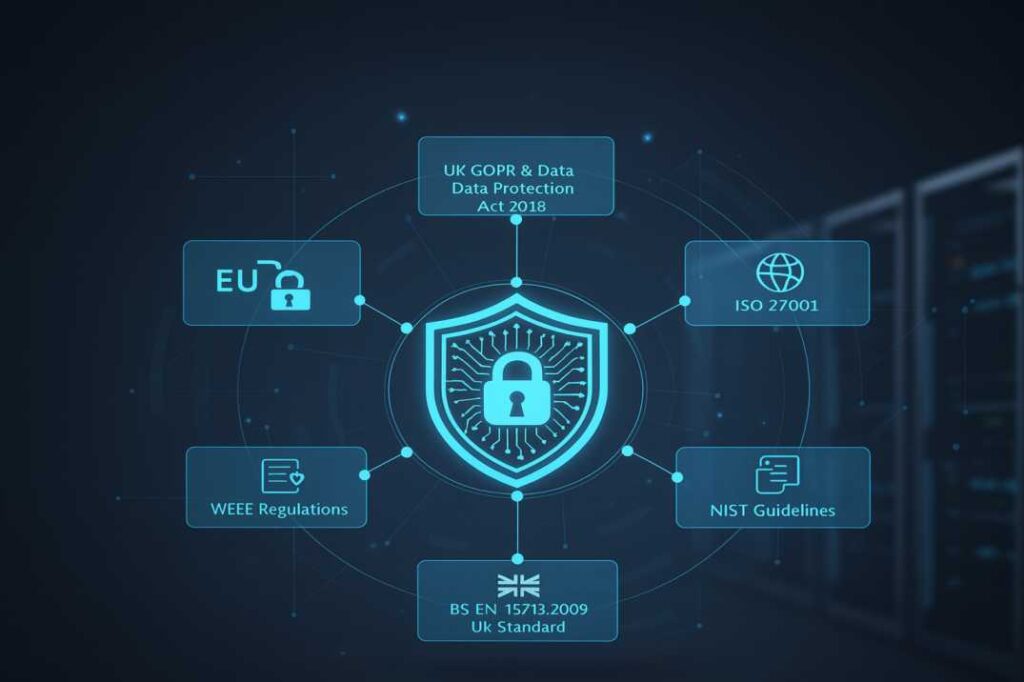
In 2026, strict data protection standards govern how businesses must manage and destroy sensitive information. Companies handling personal or confidential data are legally required to implement secure destruction methods that meet regulatory standards.
Key regulations include:
- GDPR (General Data Protection Regulation): Requires personal data to be erased securely.
- ISO 27001: Sets standards for information security management.
- BS EN 15713: Specific to secure destruction of confidential materials.
Total Shred complies with all these regulations, offering fully certified Data Destruction in UK services.
Overview of GDPR, ISO, and Other Standards
- GDPR (General Data Protection Regulation): This regulation—implemented in the UK via the Data Protection Act 2018 (UK GDPR)—is the foundation. It mandates that personal data must not be kept “for longer than is necessary.” Crucially, it enforces the “Right to Erasure” (Right to be Forgotten), compelling controllers to delete data promptly upon request. Compliance requires appropriate technical and organisational measures, making the use of certified destruction methods and obtaining a Certificate of Destruction a necessity.
- ISO 27001: This international standard for Information Security Management Systems (ISMS) requires a documented, systematic approach to managing sensitive company and customer information. Organisations with ISO 27001 certification must have stringent procedures for the secure disposal of media, providing an essential framework for Data Destruction in UK.
- BS EN 15713:2009: This is the specific British Standard for the Secure Destruction of Confidential Material. Compliance with this standard governs the security of the entire process, including staff vetting, secure collection containers, and facility security. Choosing a provider that adheres to BS EN 15713, such as Total Shred, is a strong measure of due diligence.
Legal Obligations for Businesses Handling Data
A business acts as the data controller and is thus fully accountable for the data, even when outsourcing the destruction process. Legal obligations include: maintaining a Data Retention Policy defining the lifespan of all data; ensuring a verifiable chain of custody when transferring assets for destruction; and, most importantly, obtaining and retaining a formal, auditable Certificate of Destruction for every piece of data-bearing media destroyed. This document is the required proof for auditors and regulators.
Ensuring Compliance Through Proper Destruction Methods
Compliance is achieved when a data destruction method meets the severity level required by the data’s sensitivity. For instance, highly confidential data must be destroyed to a standard that guarantees no forensic recovery. This means moving beyond simple degaussing for all media and embracing the physical destruction of devices like Solid State Drives (SSDs) and flash media, where data wiping is not a reliable method.
What Are the Most Effective Methods of Secure Data Destruction?
There is no one-size-fits-all approach — the best method depends on the type of media, sensitivity of data, and compliance requirements. Secure destruction methods are divided into physical and digital categories.
Total Shred offers a full range of services, from professional shredding services in the UK to product destruction in UK, covering every business need.
Physical vs Digital Destruction Methods
- Digital Sanitisation (Data Wiping/Erasure): This involves software overwriting the existing data on a hard drive (HDD) with random or fixed patterns (e.g., zeros). While economical for reusable HDDs, its effectiveness on modern Solid State Drives (SSDs) is highly questionable due to advanced data mapping and wear-leveling techniques. Another digital method is Cryptographic Erasure, where the encryption key for an encrypted drive is permanently destroyed, rendering the data mathematically inaccessible.
- Physical Destruction: This is the brute-force, highest-assurance method. It involves mechanically destroying the storage media into fragments so small that data reconstruction is physically impossible. This method is the undisputed standard for highly sensitive data and for all SSDs and flash media.
Degaussing, Shredding, and Data Wiping Techniques
- Data Wiping: While a good first step for HDDs intended for re-use, it is not considered sufficient for the absolute destruction of highly sensitive data or for use on SSDs, as confirmed by numerous international security bodies.
- Degaussing: This technique uses a massive magnetic field to instantaneously scramble the data stored on magnetic media like HDDs and tapes. It is fast and effective, but it renders the device unusable and is completely ineffective against non-magnetic media such as SSDs, flash drives, and optical discs.
- Shredding/Disintegration: This is the most effective and verifiable destruction method for all media types. Industrial shredders, used by professional shredding service in the UK providers like Total Shred, reduce hard drives, SSDs, and paper documents to tiny, irregular particles (often to security levels P-4, P-5, or P-6 under DIN 66399). This process is visually verifiable, auditable, and ensures that the data is utterly irretrievable.
Choosing the Right Method for Different Media Types
For maximum security and compliance, the choice is simple: always select a method that guarantees data irretrievability. This means physical shredding for all Solid State Drives, USBs, and mobile devices. For paper documents containing personal data, high-security cross-cut shredding is required. Certified professional shredding service in the UK providers can tailor the destruction to the specific media and required security level.
How Does Secure Data Destruction Protect Sensitive Information?

Secure data destruction safeguards sensitive information from unauthorized access, theft, and misuse. It prevents data breaches, protects personal and business data, and strengthens corporate cybersecurity measures. By destroying both digital and physical data using certified methods, companies can maintain confidentiality and customer trust. Services like Total Shred ensure compliance with GDPR and ISO standards while providing proof of destruction for accountability.
Preventing Data Breaches and Identity Theft
Secure data destruction in UK eliminates the entire category of risk associated with retired, decommissioned, or failed IT assets. If a device containing customer Personal Identifiable Information (PII) is securely destroyed, that data is permanently out of reach. This directly prevents external malicious actors or internal negligence from causing a data breach, which is the leading cause of identity theft.
Role in Corporate Data Security
By strictly adhering to data retention and destruction policies, a company ensures that proprietary information, such as financial statements, client contracts, and unique product destruction in uk designs, does not linger unnecessarily. This strategic action minimizes the amount of sensitive data on the company’s network and storage assets at any given time, thereby reducing the scope and severity of any potential future cyber-attack.
Enhancing Confidentiality and Customer Trust
In the age of heightened data privacy awareness, a clear commitment to secure data destruction is a significant driver of customer confidence. When a company can transparently state and prove, through an auditable process, that their customers’ data is permanently and responsibly destroyed at the end of its life, it solidifies the public’s perception of the organisation as a trustworthy custodian of sensitive information.
How Can You Choose the Right Secure Data Destruction Service Provider?
Choosing the right provider involves checking certifications, experience, and compliance with industry standards. Businesses should verify if the provider offers secure methods like shredding, degaussing, and data wiping. Certificates of destruction and documented processes demonstrate reliability. Total Shred, with its proven track record in Data Destruction in UK and professional shredding service in the UK, is a trusted option for secure and compliant destruction.
Certifications and Credentials to Look For
The security and reliability of a provider are proven through their certifications. Look for a commitment to:
- BS EN 15713: Mandatory for professional shredding service in the UK, demonstrating secure handling from collection to destruction.
- ISO 27001: Proves they operate an effective Information Security Management System.
- NAID AAA Certification: Considered the global benchmark for secure destruction.
- WEEE Compliance (Waste Electrical and Electronic Equipment): Essential for the environmentally responsible recycling of destroyed IT assets, a key requirement in the UK.
Total Shred, for example, is certified to rigorous standards like BS EN 15713 and ISO 9001/14001, providing a foundation of trust and compliance.
Evaluating Experience and Reliability
A proven track record, especially in high-security sectors like finance or government, indicates reliability. You must assess the provider’s ability to offer a secure, uninterrupted chain of custody. This includes security-vetted staff, GPS-tracked vehicles, and secure, locked containers at all stages of the process, from your premises to the point of final destruction.
Key Questions to Ask Before Hiring
Before entrusting your sensitive data to a third party, you must verify their process:
- What is your process for tracking each asset, including its serial number, from collection to destruction?
- Will I receive a formal, detailed Certificate of Destruction that includes the date, location, method used, and the asset’s unique identifier?
- Do you use on-site mobile shredding, and what is the maximum particle size achieved for both hard drives and paper documents?
- Are your personnel background-checked and security-vetted to a standard like BS7858?
How Should Different Types of Data and Devices Be Securely Destroyed?
Different media require different destruction methods for complete security. Hard drives and servers may require shredding or degaussing, while SSDs and flash drives need secure data wiping or physical destruction. Paper documents should be industrially shredded, and obsolete products should undergo certified product destruction in UK. Choosing the correct method ensures no recoverable data remains and maintains legal compliance.
Destruction of Hard Drives, Servers, and Storage Media
For all magnetic hard drives (HDDs), servers, and storage media that have reached end-of-life, the safest option is certified physical destruction. For Solid State Drives (SSDs), USB sticks, and flash memory, physical shredding is the only universally accepted method to ensure all data cells are destroyed beyond recovery. Services like those offered by Total Shred use industrial-grade shredders that guarantee the media is reduced to fragments smaller than what is required for forensic reconstruction.
Handling Paper Documents and Confidential Records
Physical documents are often overlooked but pose a serious compliance risk. Confidential paper records—client lists, HR files, financial reports—must be destroyed using a cross-cut shredder that meets a minimum of DIN P-4 security level. Outsourcing this to a professional shredding service in the UK is typically far more secure and efficient than relying on an office shredder, as the service provides a verifiable, high-security shred and the all-important Certificate of Destruction.
Managing Mobile Devices and Cloud Data
- Mobile Devices (Smartphones, Tablets): Since these contain SSD technology, they must be included in the physical destruction protocol. They cannot simply be factory reset or wiped.
- Cloud Data: While cloud destruction is managed by the provider, your responsibility remains. You must ensure your contract with the cloud provider clearly mandates data deletion upon termination, that the method used meets an approved standard, and that you receive verifiable deletion logs or attestation.
What Are the Costs and ROI of Secure Data Destruction Services?
The cost of secure data destruction depends on the type and volume of data, frequency of service, and chosen methods. While there is an upfront cost, the ROI includes preventing data breaches, avoiding fines, and protecting reputation. Long-term, certified services like Total Shred save money by mitigating risks and ensuring regulatory compliance, making the investment worthwhile for businesses of all sizes.
Understanding Service Pricing and Packages
Service pricing is typically based on volume, media type, and whether the service is performed on-site (witnessed destruction) or off-site (secure collection and transportation). When considering the cost, look beyond the basic shredding fee to the complete package: the provision of lockable bins, secure collection, certified destruction, and the issuance of the Certificate of Destruction. This holistic service, provided by professional shredding service in the UK companies, is what you are truly paying for—risk removal.
Financial Benefits of Preventing Data Breaches
The ROI is the cost of a breach avoided. The financial impact of a data breach includes not just the regulatory fines mentioned earlier, but also the enormous cost of downtime, customer compensation, and the long-term cost of lost business. Investing a modest amount in a certified destruction service is a high-leverage insurance policy against millions in potential losses.
Long-Term ROI of Data Destruction Compliance
By implementing a formal destruction policy, organisations also reap long-term operational and financial benefits, including a reduced need for expensive data storage, improved employee productivity (as they spend less time managing obsolete files), and quantifiable corporate goodwill from being a responsible data steward.
What Are the Best Practices for Implementing Secure Data Destruction in Your Organization?
Best practices include creating a formal data destruction policy, training employees on compliance procedures, and regularly auditing destruction processes. Documenting destroyed data with certificates ensures accountability. Partnering with certified providers like Total Shred ensures all physical and digital assets are destroyed securely while meeting legal and industry standards.
Creating a Comprehensive Data Destruction Policy
This policy is the ultimate blueprint. It must define data retention periods for every category of information (e.g., HR, finance, customer PII), the roles and responsibilities for authorising destruction, and the exact, verifiable method to be used for each media type. This document should explicitly mandate the use of certified professional shredding service in the UK providers and the retention of all Certificates of Destruction.
Employee Training and Awareness Programs
The human element is the weakest link. Employees must undergo regular training to understand the data lifecycle, how to identify confidential material, and the specific procedures for disposal (e.g., using secure, locked bins for paper, following the IT asset retirement process). They must be aware that simple deletion is never enough and that the use of a compliant provider like Total Shred is mandatory.
Internal Monitoring and Compliance Auditing
A robust system of checks and balances must be in place. This includes regular internal audits to verify compliance with the destruction policy, such as checking that all retired assets have a corresponding Certificate of Destruction. This continuous monitoring ensures that the process is working as intended and provides the necessary documentation to satisfy external auditors.
What Are the Most Common Mistakes in Secure Data Destruction Compliance — and How to Avoid Them?
Common mistakes include overlooking small storage devices, failing to maintain certificates of destruction, and using non-compliant service providers. These errors can result in fines, breaches, or reputational damage. Avoid mistakes by auditing all data sources, using certified providers like Total Shred, and maintaining proper documentation for every destruction process.
Overlooking Small Storage Devices
A common and costly error is focusing only on main hard drives while forgetting smaller, ubiquitous devices. USB sticks, SD cards, CDs, and even the internal memory of printers and network switches frequently hold sensitive data and must be included in the formal destruction process. Every device that has ever held confidential data must be destroyed.
Failing to Maintain Certificates of Destruction
The Certificate of Destruction is the single most important document in your compliance arsenal. Without this legal record, you cannot prove that the data was destroyed securely and in line with regulations. Organisations must treat these certificates as critical financial and legal records, maintaining a detailed, accessible log for auditing purposes.
Choosing Non-Compliant Service Providers
Prioritising cost savings over security can be disastrous. Choosing an uncertified vendor who cannot provide a guaranteed chain of custody or a verifiable destruction process is a direct failure of due diligence. Always partner with certified specialists like Total Shred who demonstrate adherence to standards like BS EN 15713 and can provide a professional shredding service in the UK that meets the highest security requirements for data and product destruction in uk.
What Does the Future Hold for Secure Data Destruction in 2026 and Beyond?
The future of secure data destruction includes automation, smart destruction technologies, and stricter global regulations. Emerging innovations will make processes faster, more reliable, and fully traceable. Businesses will need to adopt modern solutions and partner with certified providers like Total Shred to stay ahead of compliance requirements and ensure complete protection of sensitive data.
Emerging Technologies and Innovations
As storage density increases, so too must the destruction capability. Future innovations will focus on more precise physical destruction methods to ensure even the microscopic data cells on advanced SSDs are fully destroyed. We are also likely to see greater adoption of Cryptographic Erasure as a standard procedure for repurposable hardware.
Automation and Smart Data Destruction Solutions
The trend towards “smart” asset management will automate the entire data destruction workflow. IoT sensors and asset management software will automatically trigger a secure destruction process and generate the auditable log and Certificate of Destruction the moment an IT asset is retired, removing human decision-making and solidifying the chain of custody.
Stricter Global Regulations and Compliance Trends
Expect to see existing data protection laws, like GDPR, enforced with even greater rigour. New regulations emerging across the globe will likely mirror the strict accountability and punitive fines seen in the UK and Europe, pushing businesses towards a universal, high-security standard for data disposal. The need for verified, certified destruction will only increase.
Final Thought: Why Staying Ahead in Data Destruction Compliance Is a Smart Business Move
In 2026, the secure disposition of data is a non-negotiable part of a healthy business. It’s an investment in integrity, a hedge against financial ruin, and a clear signal of your commitment to customer and corporate security. By partnering with a trusted and certified expert like Total Shred to provide a professional shredding service in the UK for all your paper, IT assets, and product destruction in uk, you transform a compliance burden into a powerful competitive advantage. Stay secure, stay compliant, and secure your future.
FAQs About Commercial Document Shredding
Why is physical shredding the best method for Solid State Drives (SSDs)?
Physical shredding is the only method guaranteeing irreversible data destruction on SSDs because software wiping is unreliable due to wear-leveling technology. It is the mandatory method for high-security Data Destruction in UK.
What is the most severe consequence of non-compliant data destruction?
The most severe consequence is facing a massive GDPR fine, which can reach up to €20 million or 4% of global annual turnover, plus catastrophic reputational damage from the resulting data breach.
Is it legally required to obtain a Certificate of Destruction?
While not explicitly mandated, the Certificate of Destruction is your mandatory evidence for GDPR’s Accountability Principle, proving that data was securely destroyed to auditors and regulators.
How does Total Shred ensure a secure Chain of Custody?
Total Shred secures the chain of custody using locked collection consoles, security-vetted staff (to BS7858), GPS-tracked vehicles, and issuing a detailed Certificate of Destruction upon completion.
Does GDPR require the destruction of old uniforms or branded items?
While not personal data, product destruction in uk is essential for GDPR compliance if items (e.g., ID badges, uniforms) contain personal data or pose a security risk that could lead to a breach.