

Schools, councils, NHS trusts and government bodies hold some of the most sensitive information in the country: pupil records, safeguarding files, housing and benefit claims, social care notes, planning objections and staff records. When that information reaches the end of its retention period, it has to be destroyed securely and in a way you can prove. That is what public sector data destruction is about.
Total Shred provides secure document shredding and hard drive destruction for public sector organisations across London and the South East from our site in Stanmore. We already work with councils, NHS trusts and schools, and every job is carried out to BS EN 15713 with a certificate of destruction for your records.
Why public sector data destruction needs extra care
Every organisation has a duty under UK GDPR to keep personal data secure and to dispose of it properly. Public bodies carry some additional responsibilities that make getting it right even more important.
You hold data about vulnerable people. Children, patients, social care users and people in financial hardship make up a large share of the records public bodies keep. A breach affects people who are often least able to protect themselves.
Every public authority must have a Data Protection Officer. Under UK GDPR, public authorities, including maintained schools and academies, must appoint a DPO. Secure destruction, with evidence, is one of the things your DPO needs to be able to show.
Freedom of Information adds another layer. Once an FOI request has been received, destroying the requested information to prevent its release is a criminal offence under the Freedom of Information Act 2000. Destruction should follow your retention schedule, and be documented, so it is always defensible.
Mistakes become public. The ICO publishes its reprimands and enforcement action against public bodies. A data breach from a skip of old files or a council laptop sold without being wiped becomes a news story, and the damage to public trust lasts long after the incident.
Data destruction services for schools
Schools and academy trusts produce a steady flow of confidential paper: pupil records, SEN reports, safeguarding notes, exam papers, staff files, admissions forms and payroll. Much of it has long retention periods. Under the IRMS Toolkit for Schools, for example, the pupil’s educational record is kept by the last school they attend until the pupil’s 25th birthday. When those periods end, the records need to be destroyed properly, not boxed up in a cupboard or put in the paper recycling.
Our data destruction services for schools are built around the school year.
Locked consoles in staff rooms and offices so confidential paper never sits in open trays or classroom bins.
Holiday clear-outs during half terms and summer holidays, when archive rooms can be cleared without disrupting lessons.
Vetted staff on site. Our drivers and operators are vetted to BS 7858 and hold Enhanced DBS checks, which matters when anyone is working on school grounds.
IT refresh support. When old laptops, desktops and tablets are replaced, we destroy the storage so pupil and staff data can’t be recovered.
Council and local authority data destruction
Councils manage records across dozens of services, from council tax and housing to planning, licensing, social care and HR. Many departments work to different retention schedules, and office moves or service restructures can release years of archived files at once.
We support local authorities with scheduled collections for day-to-day confidential waste, one-off clear-outs for office rationalisation and archive reviews, and on-site shredding where departments want to witness destruction. Each collection comes with a certificate of destruction, so records managers can match what was destroyed against the retention schedule and keep an audit trail for information governance reviews.
Government data destruction
Government departments, agencies and arm’s-length bodies handle information under the Government Security Classifications, and each organisation’s security team decides how material at each level must be destroyed. For everyday records, a secure commercial service working to BS EN 15713 with a documented chain of custody is the standard approach. Check your department’s security guidance, or speak to your security officer, before booking destruction for classified material.
For digital media, the National Cyber Security Centre recommends that storage is sanitised in a way that matches how sensitive the data is. For end-of-life hard drives and SSDs, physical destruction removes any doubt. See our hard drive destruction service and IT equipment disposal for details.
NHS and healthcare organisations
Patient records carry some of the strictest confidentiality duties of any data. NHS organisations follow the Records Management Code of Practice for retention and destruction, and patient information must be destroyed in a way that cannot be reconstructed. Our guide to patient confidentiality explains the wider legal and ethical duty.
What we destroy for public sector organisations
Paper records: pupil and student files, case files, social care and housing records, HR and payroll, exam papers, planning documents, archive boxes. Staples, clips and folders can stay in.
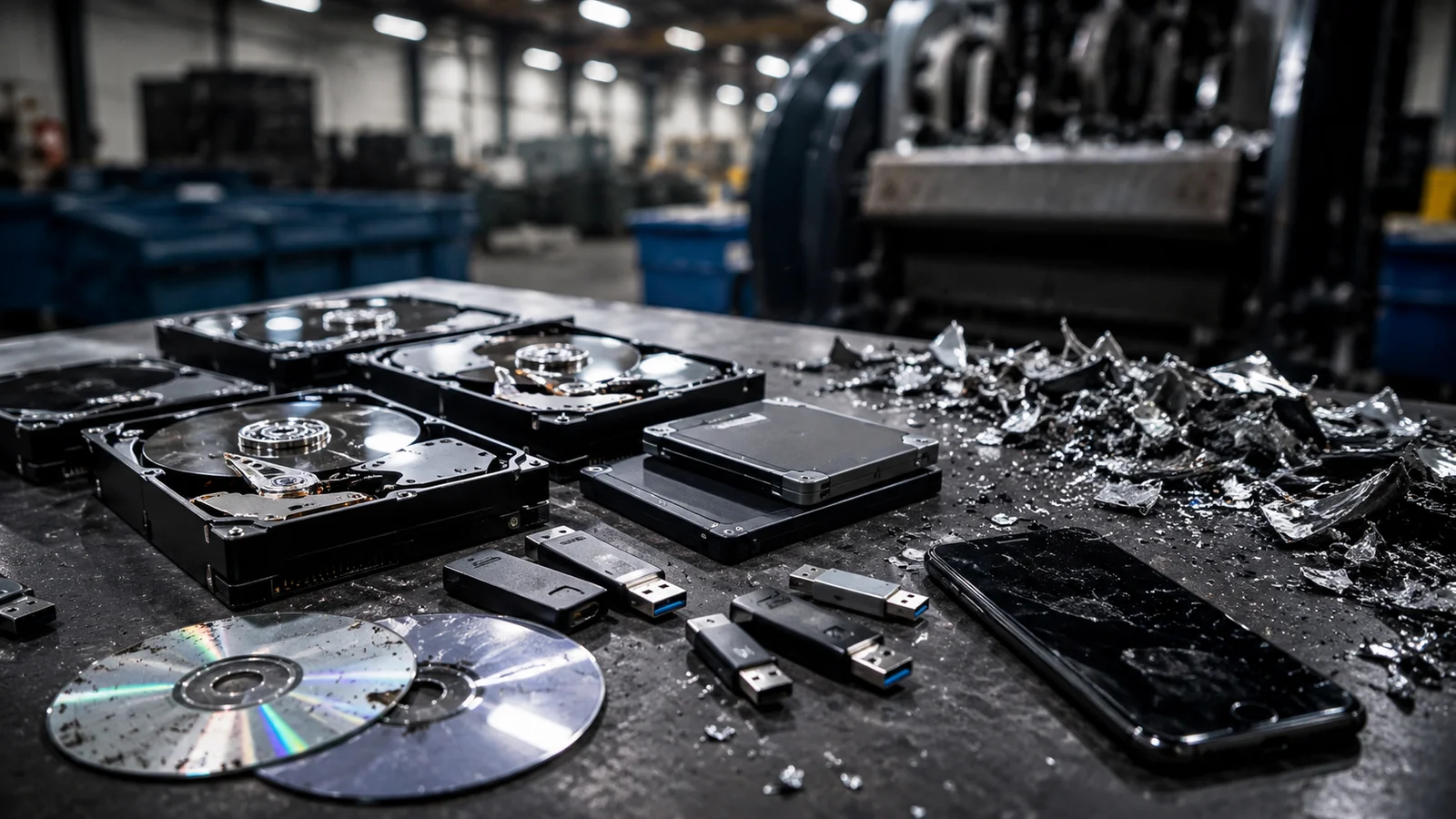
Digital media: hard drives, SSDs, USB sticks, backup tapes, laptops, tablets and phones.
Other items: staff uniforms that could be misused to gain access to buildings, through our uniform and product destruction service.
How the process works
- Tell us what you need. Volumes, locations, how often, and whether you want on-site or off-site shredding.
- We set you up. Lockable consoles or bins for regular service, or secure sacks delivered ahead of a clear-out.
- We collect or shred on site. Our mobile shredding trucks destroy material at your premises so you can witness it. Alternatively, sealed containers are collected and shredded at our secure facility.
- You receive a certificate of destruction. It records what was destroyed, when and how, giving your DPO and records manager the evidence they need. Read more about why a certificate of destruction matters.
What to look for when procuring data destruction
Whether you’re buying through a framework, a quotation or a direct award, these are the checks that matter for public sector data destruction:
BS EN 15713 compliance, covering collection, transport, storage, destruction and shred size.
BS 7858 staff vetting and Enhanced DBS checks for anyone handling your records or working on your sites.
A documented chain of custody from the moment material leaves your building.
A certificate of destruction for every job, which is essential for audits and information governance.
ISO 9001 and ISO 14001 for quality and environmental management.
Total Shred works to BS EN 15713, ISO 9001 and ISO 14001, and all our drivers and operators are vetted to BS 7858 with Enhanced DBS checks.
Social value and sustainability
Social value now carries real weight in public sector buying decisions, and secure destruction can contribute to it. At Total Shred, 100% of the paper we shred is recycled into tissue products, nothing goes to landfill, and we use energy-efficient mobile shredding vehicles. Read more about our corporate social responsibility and social value commitments.
Talk to us about public sector data destruction
Whether you’re a single primary school, a multi-academy trust, a borough council or a government agency, we’ll recommend a service that fits your volumes, sites and security requirements. Call 0800 298 4009, email shred@total-shred.com, or request a quote.
Frequently asked questions
What is public sector data destruction?
Public sector data destruction is the secure, documented disposal of records held by schools, councils, NHS bodies and government organisations once they reach the end of their retention period. It covers paper records and digital media such as hard drives, and should always come with a certificate of destruction.
Do schools need a professional data destruction service?
Schools hold large amounts of personal data about children and staff, and must dispose of it securely under UK GDPR. A professional service provides locked consoles, vetted staff, secure shredding to BS EN 15713 and a certificate of destruction that your Data Protection Officer can keep as evidence.
How long should schools keep pupil records before destroying them?
Retention periods vary by record type. Under the IRMS Toolkit for Schools, the pupil’s educational record is kept by the last school they attend until the pupil’s 25th birthday. Check your school’s retention schedule before destroying any records.
Can councils destroy records that are subject to an FOI request?
No. Once a Freedom of Information request has been received, destroying the requested information to prevent its release is a criminal offence under the Freedom of Information Act 2000. Destruction should always follow your retention schedule and be documented.
Can you destroy government documents?
We destroy government records to BS EN 15713 with a documented chain of custody and a certificate of destruction for every job. For classified material, check your department’s security guidance first, as your security team sets the destruction requirements for each classification level.
Do you destroy hard drives and IT equipment for public sector organisations?
Yes. We destroy hard drives, SSDs, USB sticks, backup tapes, laptops and other devices so the data cannot be recovered, and issue a certificate of destruction for each job.