

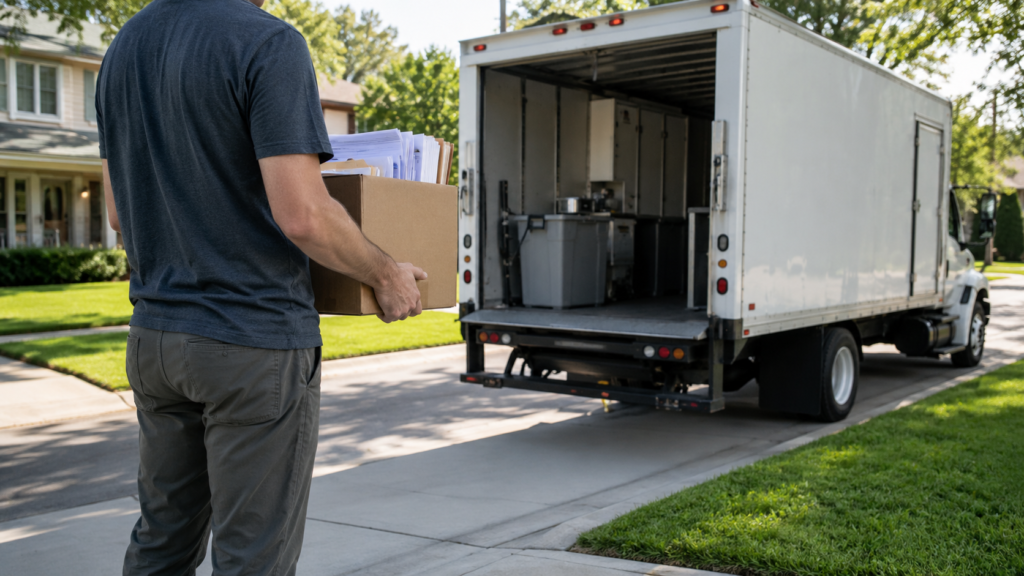
Your desktop shredder does one job. It turns confidential documents into strips inside a plastic bin that sits in your hallway until you empty it into the recycling.
That last step is the problem. Everything a private shredding service exists to prevent happens in the ten seconds between the bin and the kerb.
Private Shredding Services Destroy To A Different Standard
Consumer machines carry a DIN 66399 rating, usually P-2 or P-3. P-2 produces strips up to 800 mm² in area. P-4 caps a particle at 160 mm² and P-5 at 30 mm², which is the range professional equipment works in.
Total Shred destroys material to BS EN 15713, the British and European standard for secure destruction of confidential material. The output is particles rather than ribbons, and it joins a bulk load alongside thousands of other documents. That mixing matters as much as the particle size. Your bank statement is not sitting identifiable in a bag at the end of a driveway.
Personal Paper Shredding Services Give You Proof, Not An Empty Bin
A home machine leaves you with a full bin and nothing else. Personal paper shredding services issue a Certificate of Destruction.
For anyone clearing an estate or disposing of records from a business run from home, that certificate proves the sensitive information was destroyed, on a stated date, under a named standard. Probate solicitors ask for it. Insurers ask for it. It is the difference between peace of mind and an assumption.
Why Residential Shredding Services Handle The Volume You Can Not
A desktop machine takes six to twelve sheets and needs a cooling break every few minutes. A loft clear-out is fourteen years of statements, three lever arch files of mortgage paperwork, and a box of payslips from a job you left in 2011.
Residential paper shredding services clear that in one visit. Total Shred posts secure sacks, you fill them at your own pace, and an operator destroys the contents in the vehicle outside your address while you watch.
Domestic Paper Shredding Without Pulling a Single Staple
Staples stay in. Paper clips, treasury tags, plastic wallets and lever arch files go in as they are. Removing staples from a thousand sheets is the worst part of doing this yourself, and it is why most domestic paper shredding projects stall.
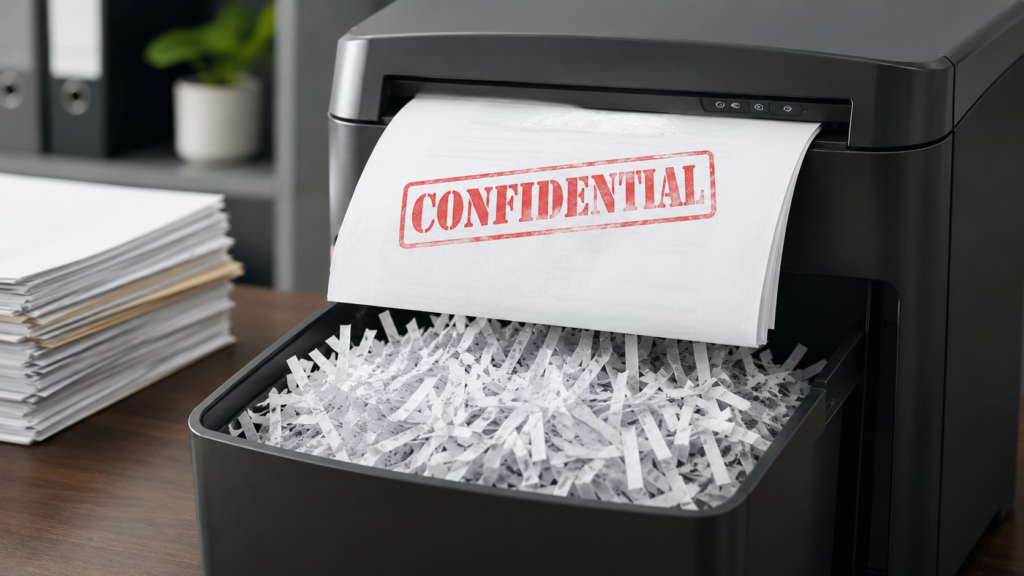
What Residential Paper Shredding Services Will Destroy
Anything carrying your name beside an account number. Bank and credit card statements. Payslips, P60s and P45s. Tax correspondence. Medical letters. Utility and council tax bills. Insurance, mortgage and tenancy paperwork. Pension statements. Anything you have signed.
Old hard drives, laptops, phones, USB sticks and SD cards go in too. Deleting files does not remove confidential data from a drive, and a wiped-looking laptop sold on a marketplace remains a common route for confidential information to leave a house.
Booking a Private Shredding Service
Residential shredding services split two ways. For household volumes, book a collection: the sacks arrive by post and the vehicle comes to you inside a two hour window with live driver tracking.
For smaller amounts, the drive-thru site at Devonshire House, 582 Honeypot Lane, Stanmore HA7 1JS accepts walk-ups. Few shredding sites in London open to the public this way.
Searching home shredding near me from outside London still works. Coverage runs UK-wide through mobile on-site destruction and secure off-site collection, so give your postcode at enquiry.
When Domestic Shredding At Your Own Desk Is Enough
For the daily trickle it is fine. Two letters, a receipt, a delivery label. Nobody should book a vehicle for four envelopes.
The switch happens on volume and on evidence. Past a box, or the moment you need to prove destruction rather than assume it, domestic shredding at the desk stops being the right tool.
FAQ
What is a private shredding service?
It destroys confidential documents on your behalf, at your address in a mobile vehicle or through secure off-site collection. Destruction meets BS EN 15713 and includes a Certificate of Destruction.
Are personal paper shredding services more secure than a home shredder?
Yes. The particle size meets the confidential destruction standard rather than the P-2 or P-3 rating typical of consumer machines, and you receive documented proof no home machine produces.
Do I need to remove staples and paper clips?
No. Staples, paper clips, treasury tags, plastic wallets and lever arch files stay in place.
How much paperwork justifies booking residential shredding services?
A single box upwards. Below that, a drive-thru visit makes more sense. A rough count of bags or boxes is enough for a price.
Can I watch my confidential documents being destroyed?
Yes. On a residential collection the shredding happens in the vehicle at your address. At the Stanmore drive-thru you watch the sacks go through before you leave.
Can I include old hard drives and USB sticks?
Yes. Reformatting does not reliably remove confidential data, so physical destruction is the only certainty.
What happens to the shredded paper?
It is baled and recycled wherever possible, which is a practical advantage over domestic shredding at home, since loose shredded paper is difficult for kerbside collection to process.