

Most businesses think about information destruction on the day the filing cabinet has to move. Someone opens a drawer, finds fifteen years of payroll, and suddenly a routine office clearance is a data protection question.
Information destruction is the whole job, not just the paper part. It covers confidential files, archive boxes, hard drives, laptops, phones, backup tapes, and anything else holding data you are legally responsible for. Shredding the paperwork and leaving four old laptops in a cupboard is not a completed job.
Total Shred handles both ends of it. We come to you with a mobile shredding vehicle, or you bring it to us.
Document Destruction Services
Our trucks shred on site, at your address, while you watch. Paper goes in intact and only shreddings come out, so nothing readable ever leaves your car park. There is no need to strip staples, paperclips or plastic wallets first. The cross-cut units handle up to two tons an hour, which is roughly a small office’s entire archive in a morning.
If you would rather not have a vehicle on site, we also run sealed collection to our facility. That route is cheaper at volume. The trade-off is that your paperwork is in transit for a while and you do not see the machine.
Both routes end the same way: a Certificate of Destruction, and everything recycled.
What to Ask Corporate Shredding Companies About Chain of Custody
Ask any corporate shredding company how they handle chain of custody. The answer tells you more than any certificate on the wall.
Chain of custody is the documented record of who held your material, when, and what happened to it at each step. It matters because the gap between “we collected it” and “it was destroyed” is where things go wrong. Material sits in a yard overnight. A subcontractor takes the run. A bin gets tipped into a general waste stream by someone having a bad Tuesday.
On-site shredding gives you the shortest possible chain. Your material moves from your building into the vehicle and is destroyed within a few feet of where it was stored. Nothing intact leaves the site. There is no transport leg, no intermediate storage, and no third party. You watch it happen, which means the chain is one link long and you are standing at the end of it.
Off-site works differently. Material goes into a lockable container, the container is sealed, the seal number is logged, and it travels to the facility under that seal. It is destroyed there, usually within twenty four hours, and the seal number appears on your certificate. That is a longer chain, but it is a documented one, and for high volumes it is the sensible economics.
What you should not accept is a chain nobody can describe. If a provider cannot tell you where your files sleep between collection and destruction, they do not know either.
IT Equipment Disposal
Deleting a file does not remove it. Formatting a drive does not either. Both operations remove the pointer that tells the operating system where the data lives, while leaving the data itself sitting on the platters or in the flash cells until something overwrites it. Recovery software that costs forty pounds will pull most of it back.
Solid state drives complicate this further. Wear levelling spreads data across cells in a way the controller manages internally, so a wipe command may leave copies in blocks the software cannot address. This is why physical destruction is the only reliable answer for a drive holding personal or commercial data, and why disposal of IT assets is a separate service rather than a line item on a shredding invoice.
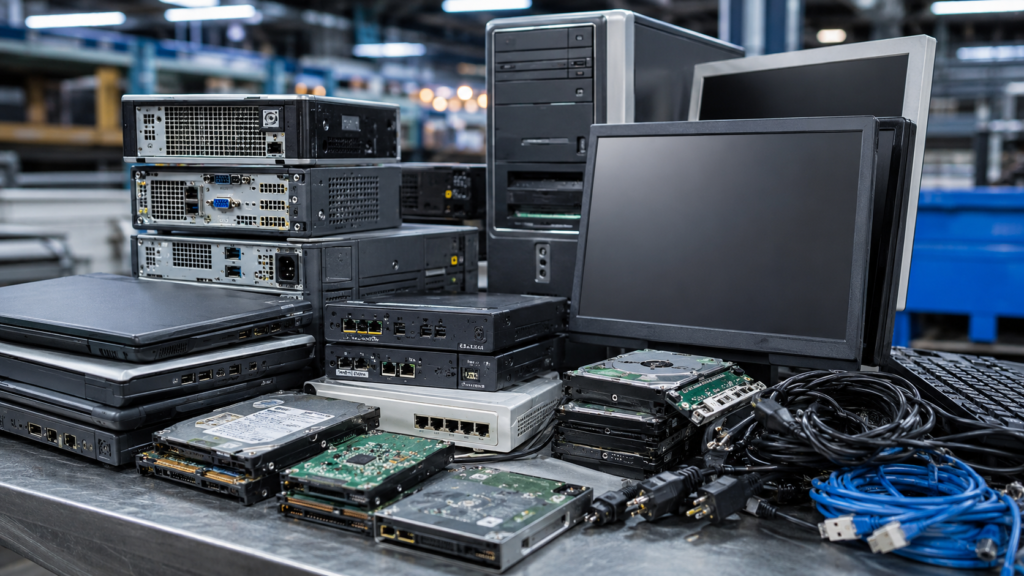
We securely destroy hard drives, solid state drives, laptops, servers, phones, tablets, USB sticks, backup tapes and CDs. Each item is logged by serial number where one is readable, destroyed, and covered by the same certificate as your paper. The serial log matters at audit: it is the difference between saying you disposed of forty laptops and proving which forty.
The reason IT asset disposal has become the sharper end of the problem: a single laptop that walks out of a decommissioning pile carries more records than a whole box of files. Regulators know this. So do the people who buy second-hand kit at auction, and there is a long run of studies where researchers bought used drives and recovered medical records, bank details and business correspondence from most of them.
Data Destruction Services Near Me
The Total Shred site is in Stanmore, at Devonshire House on Honeypot Lane, and it is the reason we can offer something most corporate shredding companies cannot.
You can drive to us. Book a slot, pull up next to the shredding vehicle, hand over your sacks, and watch the whole thing happen through the viewing window. People turn up with fifteen years of paperwork and leave twenty minutes later with a certificate. No collection charge, no waiting in for a van, no wondering where your documents went.
Most providers sell peace of mind as a phrase. Watching your own paperwork go into the machine is the version of it you can actually verify, which is why the drive-thru is the most popular service we run with people clearing a house or closing a business.
For businesses across London and the home counties, the same site is the base for our mobile fleet. Scheduled collections run daily, weekly or monthly depending on how fast your paperwork builds up.
Who We Work With
Councils, NHS trusts, schools, law firms, accountancy practices, and a lot of one-person businesses working from a spare room. The volume changes. The obligation does not.
We do not tie you into a fixed term. If a scheduled service stops suiting you, three months of written notice ends it.
Secure Shredding Services and Compliance, In Plain Terms
Secure shredding services are only worth anything if they hold up when someone asks. Ours are certified to BS EN 15713 for secure destruction, alongside ISO 9001 and ISO 14001. Every job produces a Certificate of Destruction with the date, the method, and what was destroyed.
Keep those certificates. Under UK GDPR, your organisation stays responsible for personal data right through to the point it stops existing, and the certificate is what proves that point was reached.
FAQ
What counts as information destruction?
Anything that permanently removes data from a physical medium. That covers paper shredding, hard drive destruction, and the disposal of IT assets like laptops, phones and servers. If it holds information you are responsible for, it needs destroying rather than binning.
Is shredding my own documents good enough?
For a handful of pages, yes. For anything regulated, an office shredder gives you no certificate, no audit trail, and usually a strip cut that can be reassembled. If you would struggle to prove destruction to a regulator or a client, it is not enough.
What is chain of custody, and why does it matter?
It is the documented record of who held your material at every stage between collection and destruction. It matters because that gap is where breaches happen. On-site shredding gives you the shortest chain because nothing intact leaves your building. Off-site is longer but should be documented with a sealed container and a seal number that appears on your certificate. Any provider who cannot describe their chain of custody does not have one.
Do you destroy hard drives, or just wipe them?
We destroy them physically. Software wiping can be done well, but it can also fail silently, and you have no way of checking afterwards. Physical destruction removes the question.
How much does IT equipment disposal cost?
It depends on volume and whether we collect or you deliver. Give us a rough count of drives and devices and we will price it properly rather than guessing.
Can I watch my documents being shredded?
Yes, on both routes. On site, the shredding happens in the vehicle outside your building. At our Stanmore drive-thru, you watch through the viewing window and can see the shreddings afterwards.
What do I get as proof?
A Certificate of Destruction, issued after the job and emailed to you. It records the date, the method and the material destroyed.