

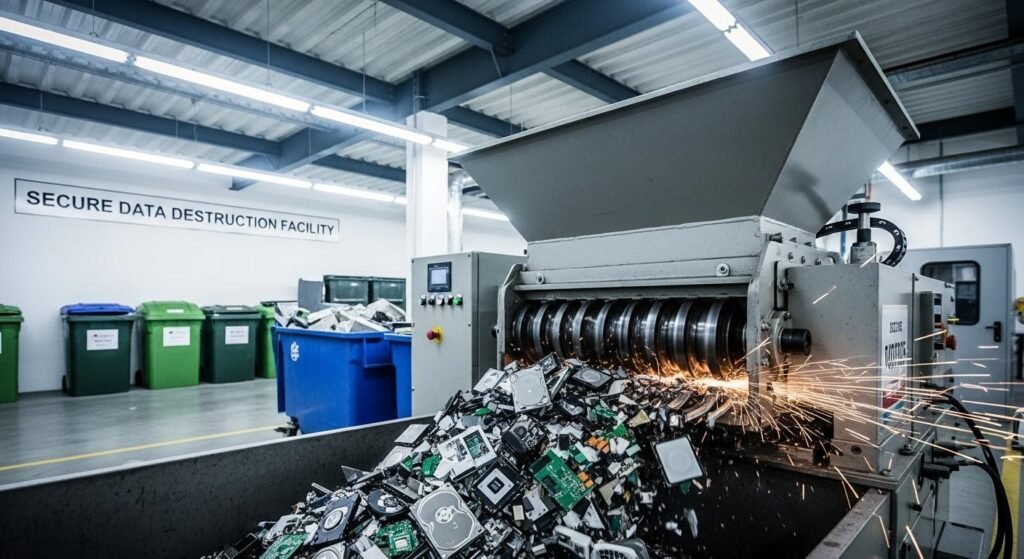
Can shredded data be recovered?
In limited circumstances, yes. Strip-cut paper has been reassembled manually and by software, and a storage device broken into large fragments can still yield readable sectors. Recovery difficulty rises sharply as particle size falls and as one document is mixed with thousands of others. Below a certain shred level, reconstruction ceases to be viable.
For organisations holding payroll records, patient notes or drive-based backups, the relevant question is not whether reconstruction is theoretically possible. It is whether the chosen method of data destruction leaves enough intact to make the attempt worthwhile.
Shred levels for document destruction
A shredder does not destroy information. It divides the carrier into fragments and relies on the difficulty of restoring their order.
DIN 66399, mirrored internationally as ISO/IEC 21964, grades paper destruction from P-1 to P-7 by the maximum surface area of a single particle. P-1 permits 2,000 mm² and P-2 permits 800 mm², both strip cuts unsuitable for confidential material. P-3 reduces this to 320 mm² and P-4 to 160 mm², the cross-cut range covering most business paperwork, with P-4 the practical minimum for personal data. P-5 tightens it to 30 mm², the micro-cut level appropriate for payroll, medical and client financial records. P-6 and P-7, at 10 mm² and 5 mm², exist for classified material.
An A4 sheet measures approximately 62,370 mm². At P-2 it becomes at least 78 long strips retaining whole lines of readable text. At P-5, over 2,000 fragments, each carrying perhaps two characters. Every additional fragment multiplies the edge matches an operator or algorithm must test.
What document reconstruction requires
Two projects are routinely cited as proof that shredded material can be rebuilt, and both demonstrate the opposite.
After the East German state security service collapsed, staff hand-tore records into what became 16,000 bags of fragments. A reconstruction team at Zirndorf has worked on them since 1990 and, according to the German Federal Archives, has completed 600 bags at an average of roughly 18 months each. Fraunhofer IPK’s pattern-matching software never reached its 80 per cent target; scanning was discontinued in 2014 and reassembly stopped in 2016, leaving around 15,500 bags unprocessed.
In DARPA’s 2011 Shredder Challenge, a $50,000 prize drew nearly 9,000 teams. The winners solved five purpose-cut documents in 33 days, investing close to 600 man-hours across more than 10,000 fragments.
Both required hand-torn or purpose-cut material, documents identified in advance, and funding from a national archive or a prize deadline. Commercial waste supplies none of these. Cross-cut fragments carry no distinguishing edge features, a single sheet arrives mixed with several hundred kilograms of unrelated paper from other clients, and once the paper is baled and pulped the fibres separate in water, leaving no matchable edges. That final stage is what makes document destruction irreversible, and it is the stage in-house bins never reach.
Recovery from a shredded hard drive or storage device
Digital storage media follow different physics, and this is where organisations are most exposed.
A hard disk records data magnetically on rigid platters. A drive broken into a few large sections may still permit laboratory recovery from an undamaged platter area. Deforming the platters and reducing them to small fragments removes that possibility.
Solid state drives and USB sticks behave differently. Data resides in NAND flash chips of small physical size, and degaussing has no effect because there is no magnetic record to disrupt. Where a chip package survives intact, a laboratory can remove it from the board and read it directly, a technique known as chip-off forensics. Shredding an SSD to 20 mm particles can leave entire chips undamaged. The US National Security Agency specifies a maximum edge size of 2 millimetres for solid state disintegrators for this reason.
NIST Special Publication 800-88 defines three levels of media sanitisation: clear, purge and destroy. Destroy requires that the storage media cannot be reused and the data cannot be recovered by known laboratory technique. Cutting a drive in half does not satisfy it.
What UK law requires for data destruction
The UK GDPR specifies no shred size. It specifies an outcome. Article 5(1)(f) requires personal data to be processed with appropriate security against unauthorised access, and Article 32 requires measures proportionate to the risk. Disposal constitutes processing, and the Data Protection Act 2018 extends the same duty to paper held in a structured filing system.
BS EN 15713, updated in 2023, is the British and European standard for the secure destruction of confidential and sensitive data. It addresses what shred size alone cannot: vetted personnel, controlled premises, locked containers, chain of custody from collection point to destruction, and a certificate of destruction as the audit record. That certificate is the evidence produced when the ICO, an auditor or a client asks how a specific batch of records was disposed of.
In practice: shred personal data at P-4 or finer and financial, medical and HR records at P-5; hold confidential waste in locked consoles rather than open bins; destroy every storage device physically rather than reformatting it; and obtain a certificate for each collection.
Total Shred
Total Shred provides secure document destruction and data destruction across the UK, operating to BS EN 15713 with full chain of custody and a certificate of destruction for every collection.
Services include on-site shredding, where material is destroyed in the vehicle at your premises under your observation, and off-site collection in locked containers for higher volumes. We also handle hard drive and storage media destruction, office clearances and recurring collections. Shredded paper is baled for recycling.
To review your current arrangement, request the certificate from your most recent collection.
Request a quote for secure shredding
FAQ
Can shredded paper be pieced back together?
Under specific conditions. Strip-cut paper retains whole lines of text and has been reassembled manually. Cross-cut and micro-cut paper produces hundreds or thousands of fragments per sheet, and once mixed into a commercial shred stream the effort exceeds any realistic benefit. After pulping, reassembly is not possible.
Is cross-cut shredding sufficient for confidential documents?
For business paperwork containing personal data, P-4 is a reasonable minimum. For payroll, medical or client financial records, P-5 micro-cut is safer. Strip-cut is unsuitable for any sensitive data.
Can data be recovered from a shredded hard drive?
This depends on fragment size and drive type. Large sections of a platter can sometimes be read in a specialist laboratory. Solid state storage media present greater risk, since an intact memory chip can be removed and read directly.
Does UK law specify a shred size?
No. The UK GDPR requires appropriate security and leaves the method to the controller, so the shred level should be proportionate to the sensitivity of the records. BS EN 15713 sets out how a secure destruction service should operate.
Is an office shredder sufficient?
For low volumes of routine paperwork it can be. The common weaknesses are the security level of the machine, the unsecured bin holding the output overnight, and the absence of an audit trail.
What is a certificate of destruction?
A dated record confirming that a specified collection was destroyed to a stated standard, presented to an auditor, a client or the ICO as evidence of compliant disposal.