

Most homes hold more confidential information than people think. Old bank statements in a drawer. Payslips from a job you left in 2014. A box of medical letters in the loft you keep meaning to sort out.
Total Shred runs home shredding for households across London and the UK. We can come to you. Or you can drive to our Stanmore site and watch it happen. Both routes are secure shredding to the same standard. Every job ends with a Certificate of Destruction. Every sheet we take is recycled.
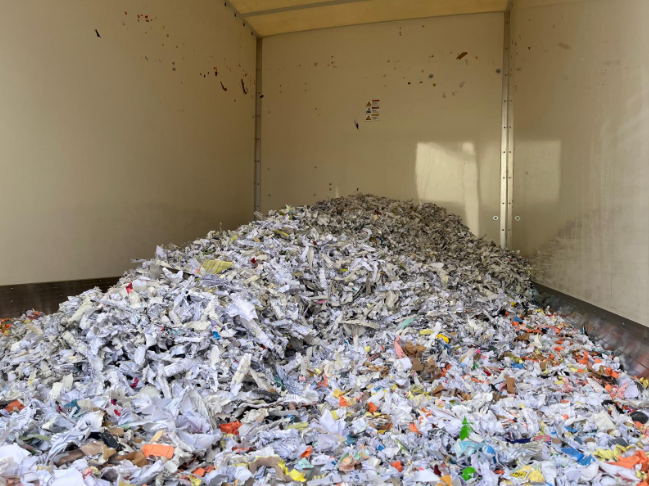
Two ways to book your home shredding
On-site shredding at your home
We come to you. Book a one-off job and Total Shred posts you secure sacks. Fill them in your own time. Our operator then shreds the contents in the vehicle outside your house. Your confidential information never leaves the address in one piece. You can stand and watch.
You do not need to sort anything first. Staples, paper clips, treasury tags, plastic wallets and lever arch files can all stay put. Pulling staples out of a thousand sheets is the worst part of this job. Our machines do not care about them.
You also get a two hour arrival window and live driver tracking. So you are not stuck in all day.
Drive-thru shredding in Stanmore
You can also bring the paper to us. Our drive-thru site sits at Devonshire House, 582 Honeypot Lane, Stanmore HA7 1JS. Few shredding sites in London are open to the public like this.
Book a slot and stay in your car. Our team unloads and shreds while you watch. Most home loads take under ten minutes. For under ten boxes it is usually the cheapest choice. You are not paying for a van and a driver to reach you.
How a Home Shredding job runs
- Tell Total Shred how much paper you have and pick a date. Bags or boxes are fine as a rough count.
- We post you secure sacks, or you bring your own boxes to the drive-thru.
- Fill the sacks at your own pace. Leave the staples and folders in.
- We shred on the day, either at your door or in the drive-thru bay. You can watch.
- You get your Certificate of Destruction. The paper heads to a UK mill.
What Home Shredding Covers
Home shredding, sometimes called domestic shredding, means secure disposal of paperwork from a house rather than a business. Same machines. Same standards. Same certificate. Only the size of the job changes. Your confidential information gets the same care either way.
Most home jobs look like one of these.
- Clearing a house before a move.
- Emptying a loft, garage or home office.
- Sorting a relative’s papers after a death.
- Getting rid of old tax records.
- Destroying a hard drive or old laptop along with the paper.
There is no minimum. One carrier bag is fine. So is forty boxes.
How much paper do you actually have?
People nearly always guess low. It helps to think in containers rather than sheets. Use this as a rough guide when you ask for a quote.
- One bag for life, filled. Around 400 to 600 sheets.
- One standard archive box. Around 2,000 to 2,500 sheets.
- One filing cabinet drawer. Around 2,500 to 3,500 sheets.
- A four-drawer filing cabinet. Around 10,000 to 14,000 sheets.
- A loft clear-out after 30 years. Usually 8 to 20 archive boxes.
You do not need to be exact. A count of bags or boxes is enough for Total Shred to price the job.
What You Should Shred
Start with anything that carries your name and address. Then go further. Thieves want paper that ties who you are to an account. A bank statement is worth far more to them than a birthday card.
Shred these.
- Bank and credit card statements.
- Payslips, P60s, P45s and tax letters.
- Medical letters, prescriptions and NHS post.
- Utility bills and council tax letters.
- Insurance papers.
- Mortgage and tenancy papers.
- Pension statements.
- Anything you have signed.
- Credit card offers and junk mail with your name inside.
Worth destroying too.
- Old hard drives, laptops and phones.
- USB sticks, SD cards and CDs.
- Expired passports and driving licences. Check the current rules first.
If you are not sure about an item, put it in the sack. Extra sheets cost you nothing.
How Long to Keep Paperwork Before You Shred
Shredding too early is its own problem. HMRC sets the only hard rules most households need to follow.
If your tax return covers personal income only, keep the records for at least 22 months after the end of the tax year. Records for the year ending 5 April 2026 should be kept until at least 31 January 2028. File late and the clock changes: keep them for at least 15 months after the date you filed.
If you are self-employed, the rule is stricter. Keep business records for at least five years after the 31 January filing deadline for that tax year. Many accountants suggest six years to be safe.
Everything else is guidance rather than law. These are the periods most people work to.
- Bank and card statements. Two years. Longer if they support a tax return.
- Payslips. Until you have checked them against your P60.
- P60s and P45s. 22 months minimum. Six years if you are self-employed.
- Utility bills. One to two years.
- Insurance policies. Until the policy ends and any claim closes.
- Mortgage statements. Until the mortgage is redeemed, then six years.
- Property deeds and completion papers. Keep permanently.
- Wills, birth and marriage certificates. Keep permanently.
- Guarantees and warranties. Until the cover expires.
Once a document passes its date, it stops being useful and stays risky. That is the point to shred it.
How much does Home Shredding Cost?
Price runs on volume, not on time. Two things move it. How much paper you have. Whether we come to you or you come to us.
On-site shredding costs a little more. A van and a vetted operator have to reach your door. Drive-thru costs less per bag for that reason. Regular collections work out cheapest per kilo, but few homes need them.
Be wary of very low quotes. This trade has three real costs. Fuel. Vetted staff. Safe disposal. A cheap quote means someone is cutting one of them. Ask what the price covers before you book. Ask whether the Certificate of Destruction costs extra.
Total Shred quotes a fixed price up front. Just say how many bags or boxes you have.
Why a home shredder is not really shredding
Shop-bought shredders cut paper into strips. Strips can be taped back together, and people have done it. Cross-cut models are better. They are also slow. They get hot after ten minutes and they jam on staples.
Then comes the bigger problem. The strips sit in a bin bag in your kitchen. The paper is still yours. It usually ends up in a wheelie bin on the pavement overnight.
Cheap strip-cut machines sold for home use often sit at P-1 or P-2. That is a particle the size of a postage stamp or larger. A determined person with time can work with that.
Industrial destruction sits far higher up the scale, which is why reassembly stops being realistic. Ask any home shredding company which level they shred to. A firm that cannot answer has not thought about it.
On-site or off-site shredding
Both are legitimate. They just have different chains of custody.
On-site shredding happens where your paper is. The vehicle parks outside, the paper goes in, and only shreddings leave. Nothing intact travels anywhere. You can watch the whole thing.
Off-site shredding means sealed collection, transport to a secured facility, then destruction there. It is cheaper at volume and still secure when the provider is certified. The trade-off is that your paperwork is in transit for a while, and you do not see the machine.
For a household clear-out, on-site is usually the better fit. The volumes are small enough that the price gap barely shows, and watching it happen removes any doubt.
Do You Have to Shred at Home by Law?
People often ask if the law forces them to shred. For most households, it does not. UK data protection law carves out papers you keep for purely personal reasons.
That exemption is narrower than it sounds. It can fall away if you run a business from the spare room. It can also fall away if you hold a relative’s records as an executor, or store papers for a club, charity or committee.
The real reason to shred is simpler. Fraud does not need a law to make it hurt.
How Big Is The Fraud Risk, Really?
Cifas, the UK fraud prevention service, records cases to the National Fraud Database. Its Fraudscape reports give the clearest public picture we have.
More than 444,000 cases were filed in 2025. That is the highest annual total on record and a 6% rise in 2024. It works out at over 1,200 cases a day. Identity fraud made up more than 242,000 of them, and roughly three quarters of all cases involved identity fraud or account takeover.
The first half of 2026 was worse again. Over 220,000 cases were recorded between January and June, the highest ever for that period. Identity fraud accounted for 59% of them and rose 9%, to close to 130,000 cases. Bank accounts and cards were the main targets.
Two findings matter most for households. People aged 61 and over remain the largest group hit by identity fraud. And stolen personal details are usually the way in, whether the criminal opens a new account or takes over an existing one.
Paper is not the only source of stolen details. It is just the one sitting in your loft that you can do something about this week.
Hard Drives, Phones and Other Devices
Deleting a file does not remove it. Formatting a drive does not either. Both mark the space as reusable and leave the data readable until something writes over it.
Modern drives make this harder to fix at home. Solid state drives spread writes across the chips, so an overwrite tool cannot reliably reach every copy. A factory reset on a phone is better than nothing but still depends on the encryption being set up properly.
Physical destruction removes the question. Total Shred destroys hard drives, laptops, phones, USB sticks, SD cards and CDs alongside your paper, and covers them on the same Certificate of Destruction.
Clearing a Home After a Death
Clearing a home after a death is its own kind of job. Executors often find decades of paper in one loft. Bank books, pension letters, insurance files, old wills. Much of it still carries live account numbers.
Work through it in three passes. Keep anything the estate still needs. Set aside deeds, certificates and anything unresolved. Shred the rest.
Take the certificate seriously in that situation. If a beneficiary asks later what happened to the papers, you have a dated record. It costs nothing and it saves an awkward conversation.
How To Choose Between Home Shredding Companies
Standards are what matter here. The gap between a good firm and a cheap one stays hidden until something goes wrong. Ask any private shredding service five questions.
Do you work for BS EN 15713?
This is the European standard for destroying confidential information. It sets rules on particle size, site security, transport and staff. It is the closest thing we have to a test of secure shredding. Total Shred works to it.
What shred size do you produce?
Ask for the DIN level. A vague answer about “industrial machines” is not an answer.
Do I get a Certificate of Destruction?
You should get one for every job. It shows the date and what was destroyed. If a firm charges extra for it, that tells you something.
What Happens To The Paper
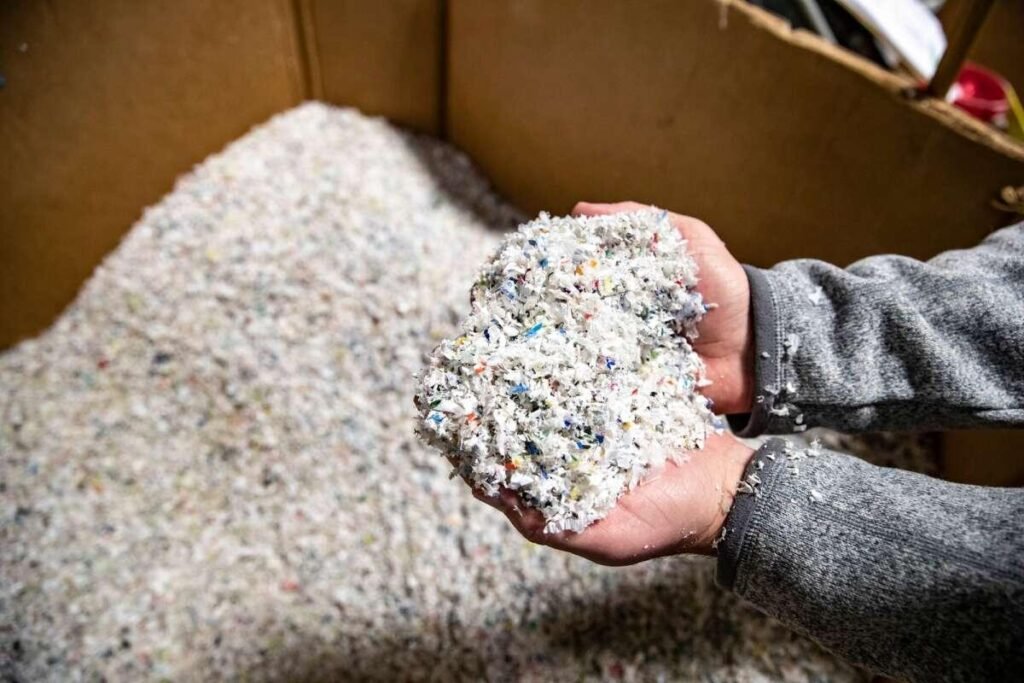
Nothing Total Shred shreds goes to landfill. The bales travel to UK paper mills and come back as tissue, card and packaging.
Recycled fibre is not endless. Each pass shortens the fibres, and paper can usually go round five to seven times before they are too short to bond. Shredding shortens them faster than sorting whole sheets would. So shredded paper tends to become tissue and packaging rather than new office paper.
It still beats the alternative on energy, and keeping the mills local keeps the transport short.
Looking For Domestic Shredding Services Near Me
Total Shred collects across London and the South East as standard. We travel further for bigger clear-outs. The Stanmore drive-thru suits north west London, Harrow, Watford, Barnet and most of Hertfordshire.
If you sit outside that area, ask anyway. Bigger jobs are often still worth the trip. If yours is not, we will say so.
Book Your Home Shredding
Tell Total Shred roughly how much paper you have. Then say if you want us at your door or you would rather use the drive-thru. We send back a fixed price, usually the same day.
FAQ
What is home shredding?
Home shredding is secure shredding of confidential information from a house. A certified firm destroys the paper for you. It covers bank statements, payslips, medical records and old hard drives. The paper is cut into pieces too small to put back together. You get a Certificate of Destruction at the end.
Is home shredding the same as domestic shredding?
Yes. The two terms mean the same thing. Some firms say residential shredding as well. All three describe the same job: destroying paperwork from a household rather than an office.
How long should keep documents before shredding them?
For personal income tax records, HMRC expects at least 22 months after the end of the tax year. If you are self-employed, keep business records for at least five years after the 31 January deadline for that year. Deeds, certificates and wills should be kept permanently. Most other household paperwork can go after one to two years.
What counts as confidential information at home?
Anything that helps someone pretend to be you or get into an account. That means bank and card statements, payslips, tax letters, medical post, pension papers and insurance papers. Add anything you have signed. Utility bills and addressed junk mail count too, because they prove your name at your address.
What shred size is secure enough?
Paper destruction is graded from P-1 to P-7 under DIN 66399, now ISO/IEC 21964. P-4 allows particles up to 160 mm² and is the common baseline for confidential information. Cheap home shredders often sit at P-1 or P-2, which leaves pieces large enough to work with.
Is there a minimum amount for personal shredding services?
No. Total Shred has no minimum. One bag is fine and so is forty boxes. Larger loads and drive-thru drop-offs work out cheaper per bag.
How much paper is in an archive box?
Roughly 2,000 to 2,500 A4 sheets. A filled bag for life holds around 500. A four-drawer filing cabinet holds somewhere between 10,000 and 14,000. A rough count of bags or boxes is enough to get a quote.
Can I watch my documents being shredded?
Yes. You can watch at your home or at the Stanmore drive-thru. With on-site shredding the work happens in the vehicle outside your door. Nothing leaves in one piece.
What is the difference between on-site and off-site shredding?
On-site shredding destroys the paper where it sits, in a vehicle outside your house, so nothing intact leaves the address. Off-site shredding means sealed collection and destruction at a secured facility. Both are secure with a certified provider. On-site suits most household jobs.
How is this different from a shredder at home?
Home shredders make strips, and strips can be taped back together. They also jam on staples and get hot fast. You are then left holding the shredded paper. Secure shredding turns paper into tiny pieces and sends it straight to a mill under a chain of custody.
Does deleting files remove data from an old laptop?
No. Deleting a file marks the space as reusable and leaves the data readable until something writes over it. Formatting does the same. Solid state drives make overwriting unreliable. Physical destruction is the only certain option for a device you are getting rid of.
Will I get proof that my papers were destroyed?
Yes. Every job comes with a Certificate of Destruction. It shows the date and what was destroyed. Keep it if you are clearing an estate or sorting records for someone else.
Do you offer domestic shredding services near me?
Total Shred collects across London and the South East, and travels further for larger jobs. The Stanmore drive-thru is open to the public and covers north west London, Harrow, Watford, Barnet and much of Hertfordshire.